 Chat with us
What Should Be Included in a Node.js Development Project Scope?
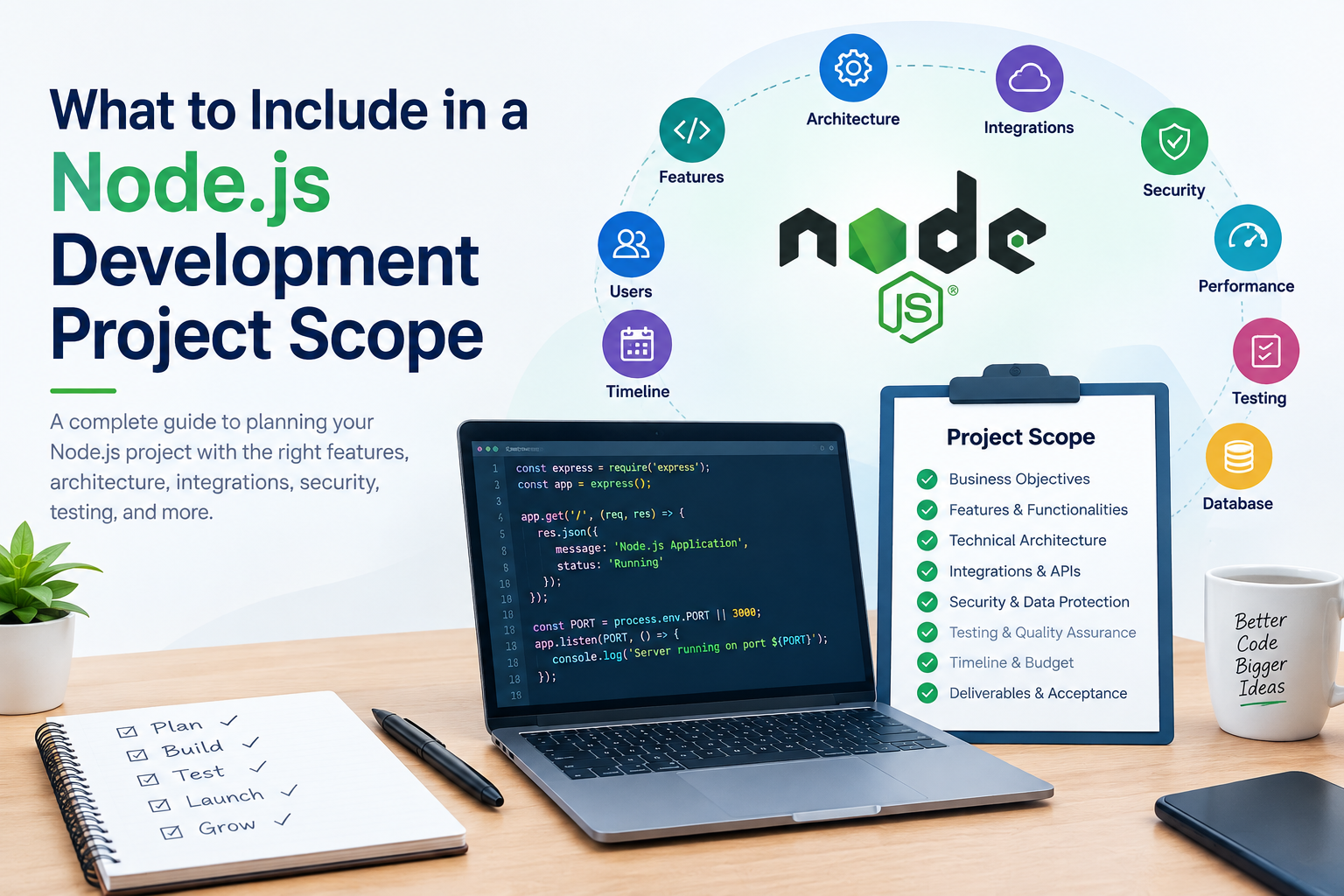
A successful software project begins with a clearly defined scope. Before starting development, businesses need to understand what the application should accomplish, which features are required, what technologies will be used, and how the project will be delivered. For companies planning to build a web application, SaaS platform, or enterprise backend, defining a clear Node.js development project scope helps align business objectives with technical execution.
Without a detailed scope, projects can experience changing requirements, unexpected costs, delayed delivery, integration challenges, and disagreements between stakeholders and developers. A well-prepared project scope provides a shared understanding of the expected outcome and gives the development team a practical foundation for planning, implementation, and testing.
Whether you are working with an in-house team or hiring a Node.js development company, here is what your project scope should include.
What Is a Node.js Development Project Scope?
A Node.js development project scope defines the objectives, features, technical requirements, deliverables, timelines, responsibilities, and boundaries of an application development project.
It explains what the development team will build, how the solution should work, and what conditions must be satisfied before the project is considered complete.
For example, the scope for a Node.js-powered SaaS platform might cover user registration, subscription management, role-based access, payment integration, REST APIs, database design, cloud deployment, testing, and documentation.
A clearly documented scope also identifies what is excluded from the initial release. This helps businesses distinguish essential launch requirements from enhancements that can be introduced later.
Business Objectives and Project Requirements
The first section of a Node.js development project scope should explain the business problem the application is intended to solve.
Technical decisions should support measurable business goals rather than being based only on preferred technologies.
Document the following:
- The business problem and expected outcome
- Target users and their requirements
- Core business workflows
- Essential application capabilities
- Expected user growth and usage patterns
- Business constraints and priorities
- Success criteria and performance expectations
For example, an ecommerce business may need a Node.js backend to manage product catalogues, orders, inventory, payments, and customer accounts. A SaaS company may require subscription management, tenant isolation, authentication, and usage tracking.
These requirements help the development team select an appropriate architecture and define the project's priorities.
Functional Requirements and Features
Functional requirements describe what the application must do. They should be detailed enough for developers, testers, and business stakeholders to understand the expected behaviour.
Depending on the project, a Node.js application scope may include:
- User registration, login, and account management
- Role-based permissions and administrative controls
- Business dashboards and reporting
- Data creation, updates, and management
- Search, filtering, and notifications
- Payment processing and subscription workflows
- Third-party API integrations
- Automated business processes
- User activity tracking and audit logs
Each major feature should include its expected behaviour, relevant user roles, validation rules, and dependencies.
It is also important to distinguish between features required for the minimum viable product (MVP) and features planned for future releases. This helps businesses control the initial development budget without losing sight of their long-term product roadmap.
Technical Architecture and Node.js Technology Stack
A project scope should outline the technical approach without unnecessarily restricting implementation details before the requirements are understood.
For Node.js development, the architecture may specify whether the application will use a modular monolith, microservices, or another suitable design. The decision should depend on business requirements, system complexity, team capabilities, and operational needs.
The technical scope may include:
Backend framework: Node.js with Express.js, NestJS, or Fastify, depending on project requirements.
Database: MongoDB, PostgreSQL, MySQL, or another suitable database based on data relationships, consistency requirements, and query patterns.
API architecture: REST or GraphQL, including API endpoints, authentication requirements, validation, and error handling.
Frontend integration: React, Vue, Angular, or an existing frontend application that communicates with the Node.js backend.
Infrastructure: Cloud hosting, environment configuration, storage, networking, and deployment requirements.
Development practices: Version control, code reviews, configuration management, and development standards.
The scope should also identify major architectural decisions and dependencies that could affect project cost, performance, security, or delivery time.
API Development and Third-Party Integrations
Many applications depend on external platforms for payments, communication, analytics, identity verification, CRM, or business operations.
If integrations are part of the project, the scope should specify which systems must connect with the Node.js application and what information needs to be exchanged.
Include details such as:
- Required third-party services
- API endpoints and integration responsibilities
- Authentication and credential management
- Data formats and validation rules
- Rate limits and usage restrictions
- Timeout and retry behaviour
- Error handling and logging
- Integration testing requirements
For example, a platform integrating a payment gateway needs to define payment initiation, confirmation, failure handling, refunds where applicable, and the processing of payment notifications.
Clearly identifying integration responsibilities reduces the risk of discovering important technical dependencies late in development.
Security and Data Protection Requirements
Security should be part of the initial Node.js project scope, not an activity left until the application is ready to launch.
The required controls depend on the application's users, data, industry, and regulatory obligations.
Common requirements include:
- Authentication and authorization
- Role-based access control
- Input validation and secure error handling
- Secure management of credentials and secrets
- Protection of sensitive information
- Encryption in transit and, where required, at rest
- Dependency and vulnerability management
- Logging and audit trails
- Backup and recovery requirements
- Data retention and deletion policies
If the application processes financial, healthcare, or other regulated data, applicable compliance requirements should be identified during planning.
The scope should define how security requirements will be verified through reviews, automated checks, and testing.
Non-Functional Requirements and Performance
Functional requirements explain what an application does. Non-functional requirements define how well it must operate.
For Node.js applications, these requirements can significantly affect architecture, infrastructure, testing, and cost.
Consider documenting:
Performance: Expected response times for important operations and APIs under defined conditions.
Scalability: Anticipated concurrent users, request volumes, and growth expectations.
Availability: Required uptime targets, recovery expectations, and operational support arrangements.
Reliability: Expected behaviour during failures, timeouts, and temporary service interruptions.
Maintainability: Code quality, documentation, monitoring, and future enhancement requirements.
Compatibility: Supported browsers, devices, operating environments, and external systems.
Whenever possible, use measurable acceptance criteria instead of vague statements such as “the application must be fast” or “the system must handle high traffic.”
Testing and Quality Assurance
Testing deliverables should be explicitly included in the project scope. A Node.js application may work during development but still fail under real-world conditions if integrations, edge cases, permissions, or performance have not been tested adequately.
The scope should identify the required testing activities, including:
- Unit testing
- API and integration testing
- Functional testing
- Security testing
- Performance and load testing, where required
- Regression testing
- User acceptance testing
- Defect resolution and retesting
It should also explain who is responsible for testing, how defects will be prioritized, and what conditions must be met before release.
For projects with complex business workflows or external integrations, independent software testing can provide an additional layer of quality assurance.
Deliverables, Timeline, and Budget
A complete Node.js development scope should state what the client will receive and when each major deliverable is expected.
Typical deliverables include source code, API documentation, database design, deployment configuration, test reports, technical documentation, and a deployed application, where included in the agreement.
The project plan should also identify:
- Major development milestones
- Dependencies and client responsibilities
- Review and approval periods
- Estimated delivery dates
- Budget and payment milestones
- Hosting and third-party service costs
- Post-launch support arrangements
Timelines and budgets should be based on the agreed requirements, complexity, integrations, team composition, and delivery model. Any estimates should state their assumptions.
Change Management and Acceptance Criteria
Requirements can evolve as a business learns more about its users or market. A project scope should explain how changes will be evaluated and approved.
A practical change management process identifies the requested change, assesses its impact on effort and timeline, and records approval before implementation.
Acceptance criteria should define when a feature or deliverable is considered complete. For example, an API may need to pass specified functional tests, enforce required permissions, return agreed response formats, and meet defined performance thresholds under a documented test environment.
This approach helps reduce misunderstandings and keeps project decisions transparent.
How to Prepare a Clear Scope Before Hiring a Node.js Development Company
Before engaging a development partner, prepare an initial requirements document that explains your business objectives, target users, essential features, integrations, preferred technologies if applicable, budget range, and expected launch date.
Ask prospective development partners to review the requirements, identify technical risks, explain architectural recommendations, and provide a breakdown of deliverables and assumptions.
An experienced Node.js development company should help clarify uncertain requirements instead of simply estimating a price from a short feature list.
At Askzenix Technologies, our development approach covers requirement analysis, architecture planning, application development, testing, deployment, and ongoing support according to project needs. Defining the scope early helps establish clearer expectations before development begins.
Final Thoughts
A well-defined Node.js development project scope connects business goals with technical requirements. It clarifies features, architecture, integrations, security, testing, deliverables, timelines, and acceptance criteria before development starts.
Investing time in scope definition can reduce avoidable rework, improve estimation, and help stakeholders make informed decisions throughout the project.
If you are planning a new application or modernizing an existing platform, Askzenix Technologies can help you evaluate your requirements and plan a Node.js development solution aligned with your business objectives. Contact our team to discuss your project scope, technical priorities, and development requirements.
Frequently Asked Questions
What should a Node.js development project scope include?
It should include business objectives, functional requirements, technical architecture, integrations, security, performance expectations, testing, deliverables, timelines, budget assumptions, and acceptance criteria.
Why is project scope important in Node.js development?
A clear scope aligns stakeholders and developers on expected outcomes. It helps control requirements changes, improve estimation, identify dependencies, and reduce misunderstandings during development.
How do you estimate the cost of a Node.js development project?
The cost depends on application complexity, required features, integrations, architecture, security requirements, team size, testing needs, infrastructure, and support arrangements. A detailed requirements assessment provides a more reliable estimate.
Can the project scope change after development starts?
Yes. Requirements can change, but changes should be documented and assessed for their impact on cost, timeline, dependencies, and existing functionality before approval.
Who should prepare the Node.js development project scope?
The client and development team should collaborate on the scope. Business stakeholders define goals and priorities, while technical specialists assess architecture, feasibility, integrations, security, and implementation effort