 Chat with us
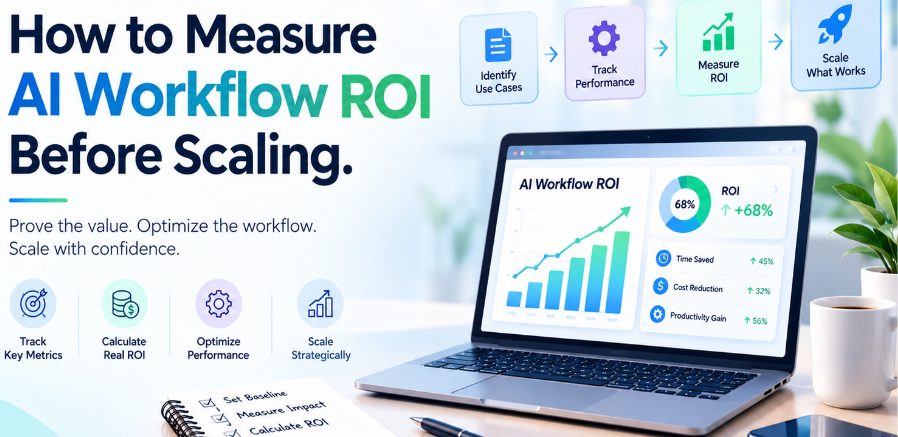
How to Measure the Business ROI of an AI Workflow Before Scaling It
Artificial intelligence can help businesses reduce manual work, improve operational efficiency, accelerate decision-making, and deliver better customer experiences. However, implementing an AI workflow does not automatically translate into measurable business value. An AI solution may perform well in a pilot project but fail to deliver the expected financial returns when deployed across departments or business operations.
Before scaling an AI workflow, businesses need to understand whether it creates measurable value, how much it costs to operate, and whether its benefits justify the investment. Measuring the return on investment (ROI) early helps decision-makers identify limitations, control implementation costs, and determine whether an AI initiative is ready for wider adoption.
What Is AI Workflow ROI?
AI workflow ROI measures the financial and operational benefits generated by an AI-powered business process compared with the total cost of implementing, integrating, operating, and maintaining it.
Unlike traditional software, AI workflows may involve variable costs related to model usage, data processing, human review, and ongoing performance monitoring. These expenses should be included when evaluating the overall return.
The standard ROI formula is:
AI Workflow ROI = [(Total Benefits − Total Costs) ÷ Total Costs] × 100
For example, if an AI-powered document processing workflow generates ₹15 lakh in measurable annual benefits and costs ₹5 lakh to implement and operate during the same period, its ROI is 200%.
This calculation assumes that both figures cover the same period and include all relevant costs and benefits. A reliable assessment should also consider the time required to recover the initial investment.
Establish a Baseline Before Implementing AI
Businesses cannot accurately measure AI's impact without understanding how the existing process performs.
Before introducing automation, document the current workflow and collect baseline metrics. These measurements provide a reference point for comparing results after implementation.
Depending on the business process, useful baseline metrics may include:
- Average time required to complete a task
- Cost per transaction or processed document
- Number of transactions handled per employee
- Manual error and rework rates
- Average customer response or resolution time
- Monthly processing volume and operational expenditure
Consider a finance department that manually processes 5,000 invoices every month. If employees spend several minutes reviewing each invoice, the business can estimate the existing labor cost, processing time, and frequency of errors.
After introducing AI-based invoice extraction and validation, the same metrics can reveal whether automation has improved productivity and reduced operating costs.
A documented baseline also helps distinguish improvements caused by AI from changes resulting from increased staffing, lower transaction volumes, or revised business procedures.
Calculate the Total Cost of an AI Workflow
One of the most common mistakes in AI ROI analysis is focusing on development costs while overlooking ongoing expenses.
The total cost of ownership should include the full lifecycle of the workflow, from initial development to long-term operation.
Important cost components include:
- Development and implementation: AI model integration, workflow design, application development, testing, and deployment.
- Data preparation: Data cleaning, labeling, transformation, and integration with existing business systems.
- Infrastructure and model usage: Cloud hosting, API calls, computing resources, storage, and third-party AI services.
- Human supervision: Employee review of AI outputs, exception handling, and approval of sensitive decisions.
- Maintenance and monitoring: Performance evaluation, model updates, security controls, and troubleshooting.
- Integration and compliance: Connecting the workflow to ERP, CRM, accounting, or document management systems, along with applicable privacy and regulatory requirements.
For example, an AI workflow that reduces processing time but requires extensive manual correction may deliver less value than expected. Including human review and exception-handling costs provides a more realistic picture of profitability.
Measure Benefits Beyond Time Savings
Reducing manual effort is an important AI benefit, but it does not always produce direct financial savings. Businesses should separate measurable cost reductions from potential productivity gains.
Operational cost savings: Calculate reductions in overtime, outsourced processing, rework, or other expenses that can genuinely be avoided.
Productivity improvements: Measure additional work employees can complete with the same resources. Convert these gains into financial value only when they support measurable outcomes, such as increased output or avoided hiring.
Accuracy and quality: Track fewer processing errors, reduced duplicate entries, improved data consistency, and lower costs associated with corrections.
Faster turnaround: Measure how AI reduces processing delays, accelerates approvals, or improves customer response times.
Revenue impact: Where relevant, evaluate whether AI improves lead conversion, customer retention, sales productivity, or revenue per customer.
Avoid assigning a monetary value to every improvement without evidence. For example, saving 100 employee hours per month does not necessarily mean the business has saved the equivalent salary cost. The financial benefit depends on how those hours are used.
Evaluate AI Workflow Performance During a Pilot
A pilot project should test both technical performance and business outcomes. A workflow that produces accurate outputs in a controlled environment may behave differently when exposed to real-world data, exceptions, and higher transaction volumes.
During the pilot, track metrics such as:
- Percentage of tasks completed without human intervention
- AI output accuracy against verified results
- Human correction and escalation rates
- Average cost per completed task
- Processing time compared with the original workflow
- System availability and failure rates
For document processing, for example, measure field-level accuracy, the percentage of documents requiring manual review, and the number of errors that reach downstream systems.
Businesses should also define minimum acceptance criteria before the pilot begins. These criteria might include a maximum acceptable error rate, a target reduction in processing cost, and minimum system reliability.
The goal is not simply to demonstrate that the AI works. It is to determine whether it performs reliably enough to justify broader deployment.
Use a Break-Even Analysis Before Scaling
ROI indicates the return generated by an investment, while break-even analysis estimates when cumulative benefits will cover the costs.
Suppose an AI workflow costs ₹6 lakh to implement and ₹1 lakh per month to operate. If it generates ₹2 lakh in verified monthly benefits, the net monthly benefit after operating costs is ₹1 lakh.
Under these simplified assumptions, the initial implementation cost would be recovered in approximately six months.
Businesses should use conservative estimates and account for changes in usage, model pricing, staffing requirements, integration complexity, and exception rates. Scaling may also introduce new costs that were not visible during the pilot.
A financial model with conservative, expected, and optimistic scenarios helps decision-makers understand how sensitive the investment is to changing conditions.
Identify Risks That Can Reduce AI ROI
AI workflows can lose value when their outputs are inconsistent, their data quality deteriorates, or employees do not trust the results.
Before scaling, evaluate risks such as inaccurate outputs, privacy exposure, unauthorized access, integration failures, unexpected usage costs, and dependence on a single AI provider.
Establish monitoring processes that track output quality, cost per transaction, human intervention, and workflow failures over time. Define escalation rules for low-confidence outputs and high-impact decisions.
Human oversight is particularly important for financial approvals, customer eligibility decisions, sensitive records, and other processes where mistakes can create significant business or compliance risks.
When Should a Business Scale an AI Workflow?
An AI workflow is ready for broader deployment when it demonstrates repeatable business value under realistic operating conditions.
Decision-makers should confirm that the workflow meets agreed performance targets, produces positive expected financial returns, integrates reliably with existing systems, and has a clear process for managing exceptions. The business should also have a plan for monitoring costs and quality after deployment.
If the pilot produces promising results but requires frequent manual intervention, the next step may be to improve data quality, refine the workflow, or strengthen integration rather than immediately increasing deployment volume.
Conclusion
Measuring AI workflow ROI before scaling helps businesses move beyond experimentation and make investment decisions based on evidence. By establishing a baseline, calculating total ownership costs, validating operational improvements, and monitoring risks, organizations can identify which AI initiatives are commercially viable.
At Askzenix Technologies, businesses can explore AI development and workflow automation solutions designed around existing systems, operational requirements, and measurable business objectives. A well-planned AI implementation should deliver more than automation; it should produce sustainable, verifiable business value.