 Chat with us
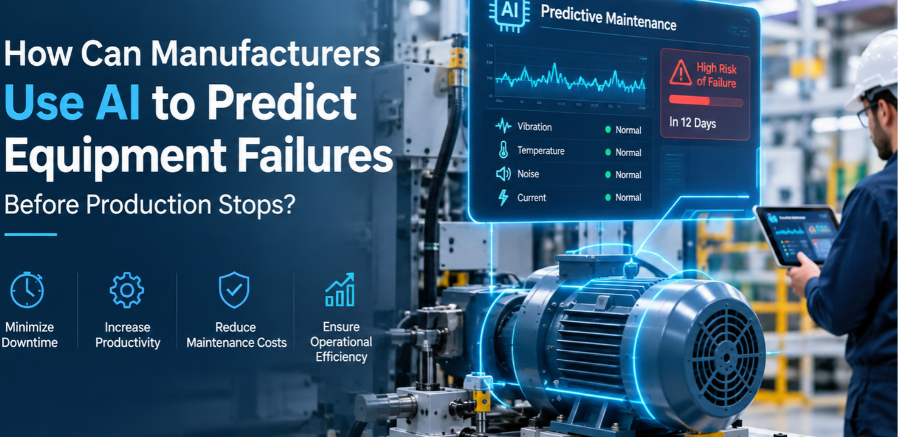
How Can Manufacturers Use AI to Predict Equipment Failures Before Production Stops?
Unexpected equipment failures can disrupt manufacturing operations, delay customer orders, increase maintenance costs, and reduce overall production efficiency. For manufacturers operating automated production lines, even a few hours of unplanned downtime can affect delivery schedules and profitability.
Traditional maintenance strategies, such as repairing equipment after it breaks or servicing machinery at fixed intervals, do not always prevent these disruptions. Artificial intelligence (AI) offers a more proactive approach by analyzing machine data, identifying early warning signs, and helping maintenance teams predict potential equipment failures before they interrupt production.
AI-powered predictive maintenance is becoming an important application of smart manufacturing, industrial IoT, and data-driven decision-making. By combining sensor data, machine learning, and real-time monitoring, manufacturers can make maintenance decisions based on actual equipment conditions rather than fixed schedules alone.
What Is AI-Powered Predictive Maintenance in Manufacturing?
AI-powered predictive maintenance uses artificial intelligence and machine learning algorithms to analyze equipment performance data and estimate when machinery may require maintenance.
Instead of waiting for a machine to fail, the system identifies patterns associated with developing faults, abnormal operating conditions, or gradual component deterioration. Maintenance teams can then investigate the problem and schedule repairs before a failure causes significant downtime.
For example, an industrial motor may gradually develop a bearing problem. Changes in vibration, operating temperature, and energy consumption can indicate that the motor is no longer functioning normally. An AI model can analyze these changes, detect unusual patterns, and alert the maintenance team to inspect the equipment.
Unlike preventive maintenance, which generally follows a predetermined schedule, predictive maintenance focuses on the machine's current condition and the likelihood of failure.
How Can Manufacturers Use AI to Predict Equipment Failures?
Analyze Real-Time Equipment Data
Industrial machines generate valuable operational data through sensors, programmable logic controllers (PLCs), supervisory control and data acquisition (SCADA) systems, and industrial IoT devices.
AI systems can analyze data such as vibration levels, temperature, pressure, electrical current, lubrication conditions, production speed, and energy consumption.
When these measurements deviate from normal operating patterns, the system can flag potential problems for further investigation.
For example, increasing vibration in a CNC machine may indicate bearing wear, misalignment, or an imbalance. Detecting these changes early helps maintenance teams investigate the cause before the issue leads to equipment failure.
Detect Abnormal Machine Behavior
Not every equipment failure follows a predictable pattern, and manufacturers may not have sufficient historical examples of every fault. This is where AI-based anomaly detection can help.
Machine learning models can learn the normal operating behavior of equipment and identify unusual patterns that differ from established baselines.
These systems can help identify overheating, unexpected pressure fluctuations, irregular motor performance, and abnormal energy consumption.
However, an anomaly does not automatically mean a machine will fail. Changes in production load, operating conditions, or product specifications can also produce unusual readings. Manufacturers should combine AI alerts with engineering knowledge and operational context to reduce false alarms.
Predict Component Wear and Remaining Useful Life
AI can help estimate the remaining useful life (RUL) of equipment components, such as bearings, pumps, motors, cutting tools, and conveyor systems.
By examining historical maintenance records, sensor measurements, machine operating hours, and failure patterns, predictive models can estimate how component degradation may progress.
For example, a manufacturing facility may use an AI system to identify a hydraulic pump showing increasing pressure fluctuations and declining performance. The system can help maintenance engineers assess whether the pump requires immediate inspection or whether maintenance can be planned during the next scheduled production window.
These estimates are not guarantees. Their accuracy depends on data quality, equipment conditions, and the availability of reliable failure records.
Identify Root Causes of Repeated Equipment Failures
Recurring breakdowns can indicate deeper operational problems, including improper installation, excessive loads, inadequate lubrication, or unsuitable operating conditions.
AI can analyze relationships between machine parameters, production conditions, maintenance history, and previous failures to help identify patterns associated with recurring faults.
For instance, a packaging line may experience repeated motor overheating during periods of high production demand. By comparing temperature readings with machine speed, workload, and operating duration, the system can help engineers investigate whether excessive load or another operating condition contributes to the problem.
This approach supports better maintenance decisions and can help reduce repeated repair costs.
Automate Maintenance Alerts and Workflows
Predicting a potential failure is useful only when the right people can act on the information.
AI predictive maintenance systems can connect with computerized maintenance management systems (CMMS), enterprise resource planning (ERP) platforms, and manufacturing execution systems (MES) to support maintenance workflows.
Depending on the integration, the system may generate alerts, recommend inspections, create maintenance requests, prioritize critical equipment, or notify supervisors.
For example, if an AI model identifies a potential conveyor motor issue, the system can notify the maintenance team and provide relevant sensor trends, fault indicators, and equipment history. The team can then assess the warning and plan the appropriate intervention.
Human review remains important, particularly when equipment failure could affect worker safety or product quality.
Key AI Technologies Used for Predictive Maintenance
Manufacturers typically combine several technologies to build an effective predictive maintenance solution.
Industrial IoT sensors collect operational measurements from connected equipment and provide the data required for condition monitoring.
Machine learning identifies patterns in historical and real-time data to classify faults, detect anomalies, and estimate failure risks.
Deep learning can help analyze complex signals, including vibration waveforms, acoustic measurements, and other high-dimensional data, when sufficient training data is available.
Edge computing processes selected equipment data close to the machines. This can reduce latency and dependence on continuous cloud connectivity for time-sensitive monitoring.
Cloud computing and data platforms support centralized data storage, model training, cross-site analysis, and monitoring across multiple manufacturing facilities.
Digital twins can combine equipment data with virtual representations of physical assets to support performance analysis and scenario testing. Their usefulness depends on the quality of the underlying models and data.
The appropriate technology stack depends on the equipment, production environment, data availability, and business objectives.
Practical Applications of AI Predictive Maintenance Across Manufacturing
AI-powered predictive maintenance can support different types of industrial equipment and production processes.
- Automotive manufacturing: Monitor robotic arms, welding equipment, conveyor systems, and assembly-line motors to identify abnormal performance before it interrupts production.
- Metal and machining operations: Analyze spindle vibration, cutting-tool wear, machine temperature, and operating conditions to help prevent unexpected CNC machine downtime.
- Food and beverage manufacturing: Monitor pumps, compressors, refrigeration systems, and packaging equipment to support reliable production and temperature-sensitive operations.
- Pharmaceutical manufacturing: Monitor critical production equipment and utility systems while maintaining appropriate documentation, validation, and quality controls.
- Industrial process plants: Analyze pumps, turbines, compressors, and rotating machinery to identify developing faults and prioritize inspections.
The greatest value often comes from applying predictive maintenance first to equipment whose failure would have the largest impact on production, safety, quality, or operating costs.
How to Implement AI Predictive Maintenance in a Manufacturing Facility
Successful implementation requires more than installing sensors or deploying a machine learning model. Manufacturers need a structured approach that connects technical capabilities with measurable operational goals.
Start With Critical Equipment
Identify machines that cause frequent downtime, expensive repairs, production bottlenecks, or significant safety concerns. Begin with a limited pilot rather than attempting to monitor every asset simultaneously.
Collect Reliable Equipment Data
Integrate relevant sensor readings with maintenance logs, historical breakdown records, operating conditions, and production information. Standardize timestamps, equipment identifiers, units, and fault codes wherever possible.
Poor-quality data can lead to unreliable predictions, so data preparation is a critical part of the project.
Develop and Validate AI Models
Select appropriate models for anomaly detection, fault classification, or failure prediction. Train and test them using representative data, and evaluate performance on equipment conditions that were not used during training.
Manufacturers should measure false alarms, missed failures, warning lead time, and prediction performance across different operating conditions. Where failures are rare, model evaluation should account for class imbalance and the practical consequences of incorrect predictions.
Integrate Predictions Into Maintenance Operations
Connect validated predictions to maintenance workflows. Define who receives alerts, how faults are verified, which issues receive priority, and when equipment should be inspected or repaired.
Maintenance engineers should be involved throughout the process to ensure the system produces actionable recommendations rather than unnecessary notifications.
Measure Results and Improve Continuously
Track unplanned downtime, mean time between failures (MTBF), mean time to repair (MTTR), maintenance expenditure, false-alert rates, and production availability.
Compare results against a reliable baseline. Monitor model performance as machines age, operating conditions change, or equipment is modified. Periodic retraining and validation may be necessary.
What Are the Challenges of AI Predictive Maintenance?
Despite its potential, predictive maintenance presents several implementation challenges.
Limited historical failure data can make it difficult to train models that accurately predict rare breakdowns. Inconsistent sensor readings, disconnected industrial systems, and incomplete maintenance records can further reduce prediction quality.
Manufacturers may also encounter integration challenges when connecting modern AI platforms with legacy machinery and existing operational technology. Cybersecurity, network reliability, employee training, and the cost of instrumentation must also be considered.
Another common mistake is assuming that every AI alert represents an imminent failure. Effective systems distinguish between anomalies, confirmed faults, and estimated failure risks, allowing maintenance teams to make informed decisions.
A phased implementation, strong data governance, clear alert procedures, and regular performance reviews can help address these challenges.
How Does AI Predictive Maintenance Improve Manufacturing ROI?
The business value of predictive maintenance comes from preventing avoidable disruptions and making better use of maintenance resources.
Manufacturers can evaluate return on investment by comparing implementation and operating costs against measurable benefits, including reduced downtime, fewer emergency repairs, lower spare-parts waste, improved asset utilization, and less production loss.
For example, if a critical machine repeatedly stops because of bearing failures, earlier detection may allow the maintenance team to replace the bearing during planned downtime instead of responding to an unexpected breakdown.
However, actual savings depend on how frequently failures occur, how accurately the system predicts actionable faults, and whether maintenance teams can intervene before production is affected. Manufacturers should calculate ROI using their own operational data rather than relying on generalized savings estimates.
Conclusion
AI is changing how manufacturers monitor equipment health, manage maintenance activities, and prevent unexpected production interruptions. By combining industrial IoT sensors, machine learning, equipment history, and connected maintenance workflows, businesses can identify early warning signs and make more informed maintenance decisions.
The most effective approach is to start with critical equipment, establish reliable data collection, validate AI predictions, and connect insights to practical maintenance actions. Over time, manufacturers can expand successful implementations across production lines and facilities.
Businesses looking to build these capabilities can explore AI development, industrial IoT integration, predictive analytics, and manufacturing software solutions tailored to their operational requirements. Askzenix Technologies helps businesses explore AI-driven software solutions that support automation, operational visibility, and data-driven decision-making.
As smart manufacturing continues to evolve, predictive maintenance can become an important part of building more reliable, efficient, and resilient production operations