 Chat with us
How AI Can Automate Quality Inspection in Manufacturing
Manufacturing companies are under constant pressure to maintain product quality, reduce production costs, and deliver products faster. Traditional quality inspection methods, which often rely on manual checks and sampling, can struggle to keep pace with high-volume production. Even experienced inspectors may overlook minor defects when inspecting thousands of components during a single shift.
Artificial intelligence (AI) is transforming manufacturing quality inspection by enabling machines to identify defects, analyze production data, and detect quality issues in real time. With AI-powered computer vision, machine learning, and automated inspection systems, manufacturers can improve product consistency, reduce waste, and make quality control more efficient.
For manufacturers exploring digital transformation, AI-powered quality inspection offers a practical way to improve production reliability while minimizing dependence on repetitive manual inspection tasks.
What Is AI-Powered Quality Inspection in Manufacturing?
AI-powered quality inspection uses technologies such as computer vision, machine learning, and image processing to examine manufactured products and identify defects automatically.
Unlike conventional inspection systems that depend on fixed rules or predefined measurements, AI models can learn to recognize different defect patterns from training data. Depending on the application, these systems can identify scratches, cracks, surface irregularities, dimensional variations, missing components, incorrect assembly, and other quality problems.
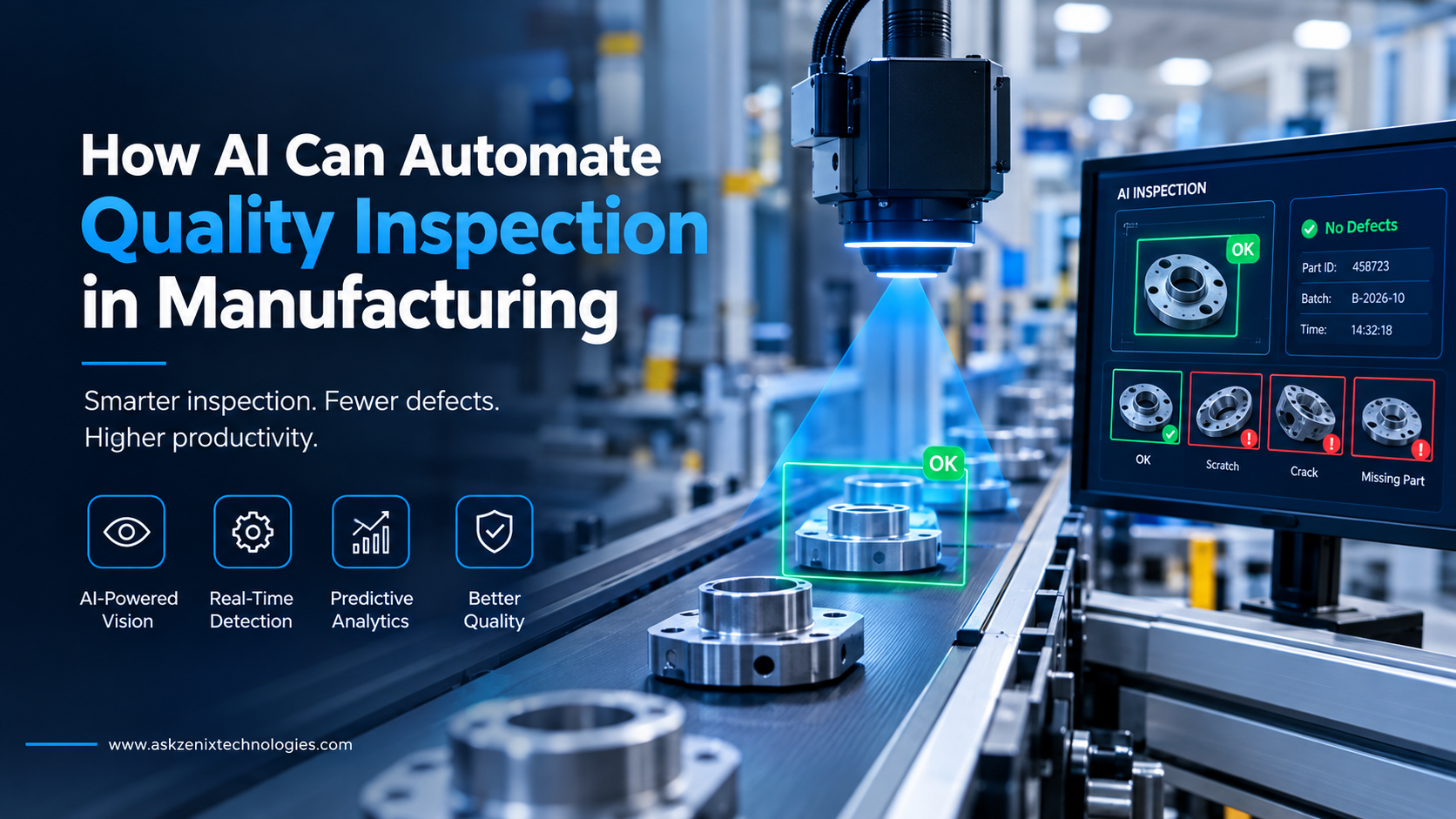
For example, an automotive parts manufacturer can install cameras along a production line to inspect metal components. An AI model analyzes images of each component, compares its features with learned quality patterns, and flags suspicious products for further inspection.
AI inspection systems can also integrate with manufacturing execution systems (MES), enterprise resource planning (ERP) platforms, and industrial IoT devices. This integration allows quality teams to connect inspection results with production batches, machine settings, and supplier information.
How AI Automates Quality Inspection on the Production Line
Automated Visual Defect Detection
Visual inspection is one of the most common applications of AI in manufacturing. Computer vision systems analyze images captured by industrial cameras to identify visible defects that may be difficult to detect consistently through manual inspection.
AI can help identify surface scratches, dents, cracks, discoloration, coating defects, and missing parts. Manufacturers can configure inspection systems to examine products as they move along conveyor belts, reducing the need to stop production for routine visual checks.
The effectiveness of these systems depends on image quality, lighting conditions, defect characteristics, and the diversity of the training data. Manufacturers should validate AI models against representative production samples before deploying them at scale.
Real-Time Quality Monitoring
Traditional quality control may identify a defect only after a batch has been produced. AI-powered inspection can analyze products during production and flag abnormalities as they occur.
When a system detects repeated defects, it can notify operators, trigger an inspection workflow, or send alerts to connected manufacturing software. Where appropriate, integration with machine controls can support automatic line adjustments or product rejection.
This approach helps manufacturers identify quality problems earlier, limit the number of defective products, and reduce the cost of rework.
Automated Dimensional and Assembly Inspection
AI can support the inspection of product dimensions, component placement, and assembly accuracy when combined with suitable cameras, sensors, and measurement techniques.
In electronics manufacturing, for example, computer vision can help verify component presence and placement on printed circuit boards. In automotive production, inspection systems can identify missing fasteners or incorrectly positioned components.
For applications requiring precise dimensional tolerances, manufacturers may need calibrated optical measurement systems, laser sensors, or other metrology equipment alongside AI software. AI should complement validated measurement methods rather than replace them where certified accuracy is essential.
Predictive Quality Analysis
AI can do more than identify existing defects. Machine learning models can analyze historical inspection results, equipment sensor readings, process parameters, and production records to identify patterns associated with quality failures.
For example, a manufacturer may discover that defects become more frequent when a machine operates at a particular temperature or vibration level. An AI system can identify this relationship and alert the production team when similar conditions occur.
Predictive quality analysis helps manufacturers investigate the causes of defects and take preventive action before problems spread across multiple production batches.
Automated Quality Reports and Traceability
Manual inspection often involves recording results, preparing reports, and updating quality management systems. These activities consume valuable time and can introduce data-entry errors.
AI-enabled inspection platforms can automatically record detected defects, inspection outcomes, timestamps, product identifiers, and production batch details. When integrated with existing business systems, this information can support audit preparation, quality reporting, root-cause analysis, and product traceability.
Manufacturers can use these records to identify recurring issues, compare defect rates across production lines, and monitor quality performance over time.
Benefits of AI Quality Inspection for Manufacturers
AI-powered quality inspection can deliver several operational benefits when implemented with suitable processes and performance monitoring.
Improved defect detection: AI models can identify complex visual patterns and inspect products consistently under validated operating conditions.
Reduced inspection costs: Automation reduces repetitive manual inspection work and allows quality professionals to focus on complex defects, investigations, and process improvement.
Lower production waste: Earlier defect identification can reduce scrap, rework, and the risk of defective products moving to subsequent production stages.
Faster production cycles: Automated inspection can process products at production-line speed, provided the inspection system meets the required throughput and accuracy targets.
Greater product consistency: Standardized inspection criteria help manufacturers apply consistent quality checks across shifts and production lines.
Better decision-making: Inspection data combined with machine and process information helps quality managers identify trends, investigate root causes, and prioritize corrective actions.
The actual return on investment depends on defect frequency, inspection labor costs, production volume, system integration requirements, and the cost of maintaining AI models and inspection equipment.
Industry Applications of AI-Based Quality Inspection
AI quality inspection can be applied across several manufacturing sectors.
In automotive manufacturing, AI can inspect painted surfaces, metal components, weld appearance, and assembly completeness. Electronics manufacturers can use computer vision to identify misplaced components, soldering irregularities, and board defects. Pharmaceutical and medical device manufacturers may use validated automated vision systems to inspect packaging, labels, seals, and product presentation.
Food processing companies can apply AI vision to identify damaged products, inconsistent sizes, foreign objects visible to the system, and packaging irregularities. Metal fabrication and industrial equipment manufacturers can use AI-assisted inspection to detect surface defects and identify patterns linked to production problems.
Each industry has different requirements for inspection accuracy, traceability, safety, and regulatory compliance. AI inspection solutions must therefore be designed around the specific product, manufacturing environment, and applicable quality standards.
Challenges Manufacturers Should Consider Before Implementing AI
AI inspection requires more than installing cameras and selecting a machine learning model. Manufacturers need representative images and production data covering normal products, known defects, and variations in operating conditions.
Another challenge is the identification of rare defects. If training data contains too few examples of a particular defect, the model may fail to recognize it reliably. Lighting changes, product variations, camera positioning, and new materials can also affect performance.
Integration is another important consideration. AI inspection software may need to communicate with existing PLCs, MES platforms, ERP systems, and quality management software. Manufacturers should also define how operators will handle uncertain predictions and how the system will be monitored when production conditions change.
A practical implementation begins with a limited use case, such as detecting a recurring surface defect on one production line. The manufacturer can measure detection performance, false rejection rates, inspection speed, and cost savings before expanding the solution.
Human oversight remains important, particularly for safety-critical products and regulated manufacturing processes. AI inspection should operate within a documented quality management process, with appropriate validation, escalation procedures, and ongoing performance monitoring.
How to Measure the ROI of AI Quality Inspection
Manufacturers should establish baseline performance before investing in an AI inspection system. Useful metrics include defect escape rate, false rejection rate, inspection time per unit, scrap and rework costs, manual inspection hours, and customer complaints related to product quality.
For example, if a production line experiences recurring defects that result in substantial rework expenses, an AI inspection pilot can measure whether earlier detection reduces those expenses without introducing excessive false alarms.
ROI (%) = (Annual net benefit ÷ Total implementation cost) × 100
Annual net benefit should account for measurable savings and additional operating costs, including software maintenance, model monitoring, equipment servicing, and integration support. A pilot based on actual production data provides a more reliable business case than assuming AI will eliminate every defect.
How Askzenix Technologies Can Help Manufacturers Adopt AI
Manufacturers looking to automate quality inspection need a solution that connects AI capabilities with their existing production workflows. This may involve computer vision development, machine learning models, industrial data integration, automated reporting, and dashboards that help quality teams act on inspection results.
Askzenix Technologies provides AI and software development services that can support businesses in developing tailored AI applications, integrating business systems, and automating data-driven workflows. The right solution depends on the manufacturer's inspection requirements, available data, production environment, and existing technology infrastructure.
Starting with a clearly defined quality problem helps manufacturers evaluate technical feasibility, validate results, and scale automation based on measurable business outcomes.
Conclusion
AI is changing manufacturing quality inspection from a largely reactive activity into a more automated, data-driven process. By combining computer vision, machine learning, industrial sensors, and production system integration, manufacturers can detect defects earlier, improve traceability, reduce avoidable waste, and gain better visibility into production quality.
The most successful implementations begin with a specific inspection challenge, measurable performance targets, and reliable production data. With appropriate validation and human oversight, AI-powered quality inspection can become an important part of a manufacturer's broader smart manufacturing and digital transformation strategy.
If your business is exploring AI-powered manufacturing solutions, Askzenix Technologies can help you evaluate AI development Services and build software aligned with your operational requirements.