 Chat with us
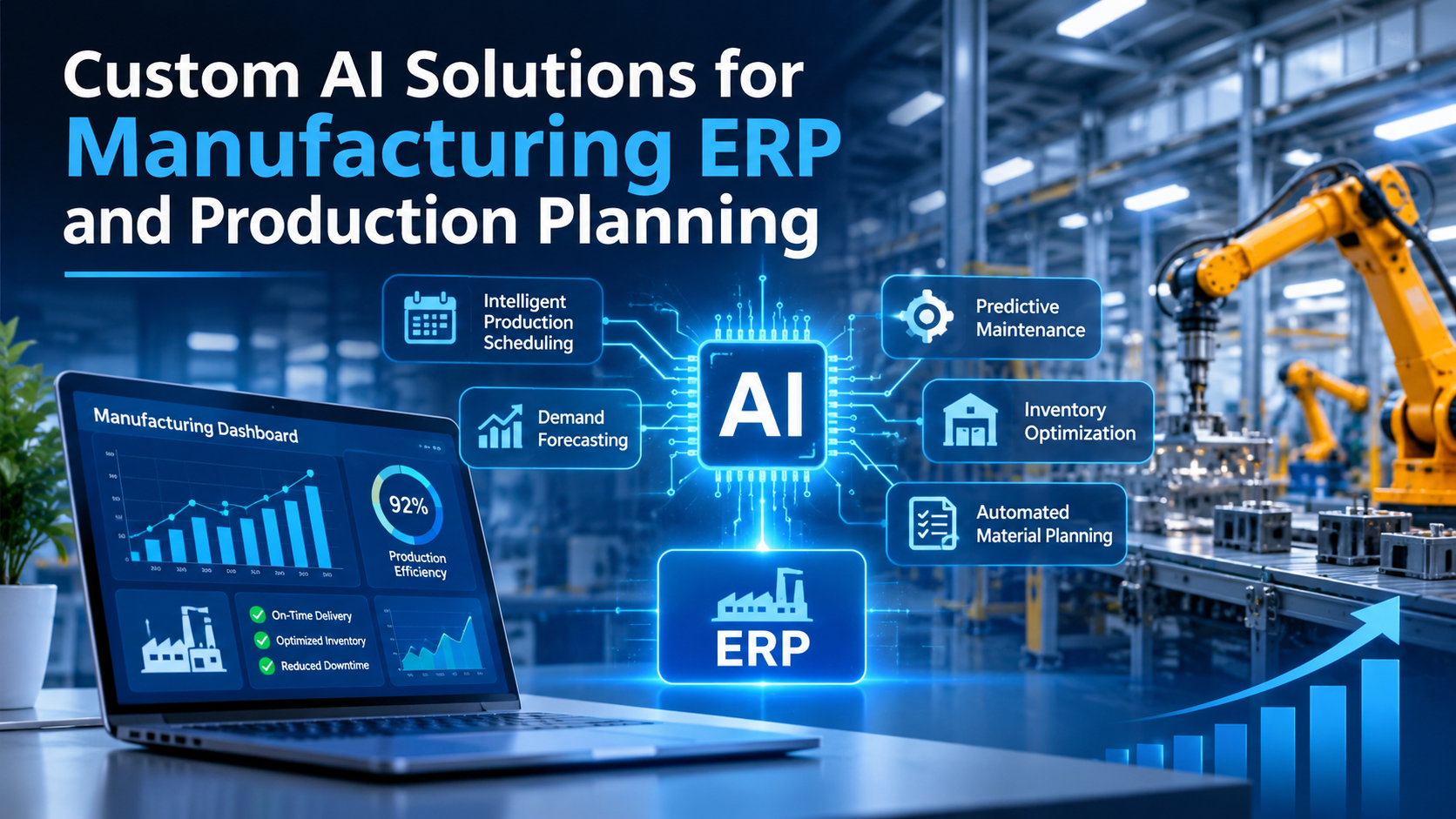
Custom AI Solutions for Manufacturing ERP and Production Planning
Manufacturing businesses are under constant pressure to increase production efficiency, reduce operational costs, improve product quality, and meet delivery deadlines. However, many manufacturers still rely on traditional ERP systems, spreadsheets, and manual planning processes to manage production schedules, inventory, procurement, and shop-floor operations. These methods can make it difficult to respond quickly to changing demand, machine downtime, material shortages, and unexpected production delays.
Custom AI solutions for manufacturing ERP and production planning help businesses turn operational data into actionable insights. By integrating artificial intelligence (AI) with existing manufacturing ERP systems, companies can improve production scheduling, forecast material requirements, identify potential bottlenecks, and make faster, data-driven decisions.
For manufacturers looking to modernize their operations, AI-powered ERP integration offers a practical way to improve visibility, streamline workflows, and build more responsive production processes.
What Are Custom AI Solutions for Manufacturing ERP?
Custom AI solutions for manufacturing ERP are software applications that use machine learning, predictive analytics, optimization algorithms, and other AI technologies to enhance enterprise resource planning systems.
Traditional ERP systems primarily record transactions, manage workflows, and provide reports. AI-enhanced ERP solutions can analyze historical and real-time operational data to identify patterns, predict future requirements, and recommend appropriate actions.
For example, an AI-enabled manufacturing ERP system can analyze historical sales, current inventory, machine capacity, workforce availability, and supplier lead times to recommend an optimized production schedule.
Unlike generic AI tools, custom AI development solutions are designed around a manufacturer's specific production processes, business rules, equipment, and reporting requirements.
How AI Improves Manufacturing ERP and Production Planning
Intelligent Production Scheduling
Production planning becomes challenging when manufacturers manage multiple product lines, changing order priorities, limited machine capacity, and tight delivery schedules.
AI-powered production planning software can evaluate these constraints and recommend production schedules that make better use of available resources. It can help identify machine conflicts, reduce unnecessary changeovers, and prioritize urgent orders.
When production conditions change, the system can recalculate schedules based on updated information.
For example, if a critical machine becomes unavailable, an AI-based scheduling solution can evaluate alternative machines, available shifts, and order deadlines to suggest a revised production plan.
Demand Forecasting and Inventory Optimization
Overstocking ties up working capital, while insufficient inventory can interrupt production and delay customer orders.
AI-powered demand forecasting analyzes historical sales, seasonal patterns, customer orders, and other relevant business data to estimate future demand. When integrated with manufacturing ERP software, these forecasts can support purchasing decisions, material planning, and inventory replenishment.
Custom AI solutions can also help manufacturers identify slow-moving materials, estimate safety stock requirements, and flag potential shortages before they affect production.
Forecasting accuracy depends on data quality, demand variability, and the suitability of the selected models. Human review remains important when unusual market conditions or one-time events affect demand.
Predictive Maintenance and Equipment Utilization
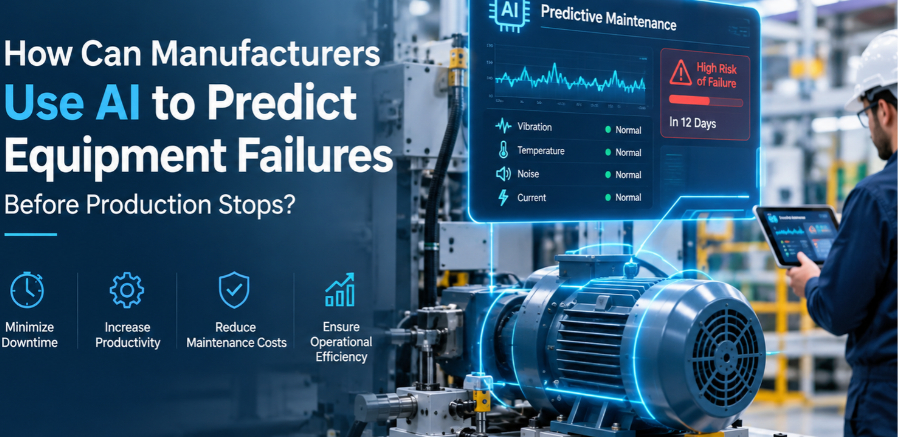
Unexpected equipment failures can disrupt production schedules, increase maintenance expenses, and reduce overall equipment effectiveness.
AI solutions can analyze machine sensor readings, maintenance records, operating temperatures, vibration patterns, and other available data to identify conditions associated with equipment failure.
When connected to ERP or computerized maintenance management systems, these insights can help maintenance teams plan inspections, schedule repairs, and coordinate spare-parts availability.
The result is better-informed maintenance planning and a lower risk of avoidable production interruptions, although actual improvements depend on equipment data, model performance, and implementation quality.
Real-Time Production Monitoring
Manufacturers need reliable visibility into production progress, work-in-progress inventory, machine utilization, rejection rates, and order completion.
Custom AI dashboards can combine information from ERP systems, manufacturing execution systems (MES), industrial IoT devices, and quality management applications.
AI models can identify unusual production patterns, highlight potential bottlenecks, and alert managers when performance deviates from expected operating conditions.
This helps production teams investigate issues earlier rather than waiting for end-of-shift reports or discovering delays after delivery commitments have been affected.
Automated Material Requirements Planning
Material requirements planning (MRP) determines which materials are needed, in what quantities, and when they should be available.
AI-enhanced MRP can use production forecasts, bills of materials, inventory levels, supplier lead times, and demand fluctuations to improve material planning recommendations.
A custom solution can flag purchase orders that may arrive late, identify shortages affecting scheduled jobs, and recommend adjustments to procurement plans.
When integrated with existing ERP workflows, these capabilities help purchasing and production teams coordinate their decisions using more consistent, up-to-date information.
Key Benefits of AI-Powered Manufacturing ERP
Manufacturers implementing AI in ERP and production planning can pursue several operational improvements:
- Improved production efficiency: Optimize schedules and resource allocation to reduce avoidable delays.
- Better inventory control: Align purchasing and stock levels more closely with expected demand.
- Reduced operational waste: Identify recurring inefficiencies, excessive changeovers, and material losses.
- More reliable delivery planning: Detect scheduling risks and evaluate alternative production plans.
- Faster decision-making: Provide managers with forecasts, alerts, and recommendations based on operational data.
- Improved cross-department coordination: Connect production, procurement, maintenance, inventory, and sales planning.
These benefits should be measured against a defined baseline. AI adoption alone does not guarantee lower costs or higher productivity; results depend on implementation, process adoption, data reliability, and ongoing monitoring.
Custom AI Development vs. Traditional Manufacturing ERP
Traditional manufacturing ERP software remains essential for managing financial transactions, inventory records, purchase orders, production orders, and business workflows.
Custom AI development extends these capabilities by adding predictive and decision-support functions tailored to specific operational requirements.
For example, a traditional ERP system may show that a production order is delayed because a material is unavailable. An AI-enhanced solution may identify the risk earlier by analyzing supplier delivery history, current stock, and planned production requirements.
Similarly, a standard ERP may provide a fixed production schedule, while an AI-based optimization engine can evaluate alternative schedules when machine capacity or order priorities change.
The strongest approach is often to enhance an existing ERP system rather than replace it unnecessarily. The right architecture depends on the manufacturer's current software, data availability, integration requirements, and long-term technology roadmap.
How to Implement AI in Manufacturing ERP Systems
Successful AI implementation begins with a clearly defined business problem rather than selecting technology first.
Manufacturers should identify a measurable use case, such as reducing production scheduling conflicts, improving demand forecasting, or predicting material shortages. They should then assess ERP data quality, historical records, integration capabilities, and the availability of real-time machine or shop-floor information.
The next step is to develop a focused pilot that integrates with relevant systems and allows operational teams to validate AI recommendations against actual production conditions.
Before expanding the solution, businesses should evaluate measurable indicators such as schedule adherence, forecast error, inventory turnover, unplanned downtime, and on-time delivery.
Security, access control, data governance, human oversight, and system reliability should also be included in the implementation plan. AI recommendations that affect critical production decisions should have appropriate approval and fallback procedures.
How Much Do Custom AI Solutions for Manufacturing ERP Cost?
The cost of custom AI development for manufacturing ERP depends on the scope of the solution, the complexity of existing systems, data readiness, integration requirements, and the number of production facilities involved.
A forecasting dashboard using existing ERP data will generally require less effort than a comprehensive platform connecting ERP, MES, IoT sensors, predictive maintenance, and automated scheduling.
Manufacturers should evaluate the total cost of development, data preparation, infrastructure, integration, model monitoring, and ongoing support. A pilot project focused on one high-value operational challenge can help establish feasibility and estimate the business value before a larger investment.
Choosing the Right AI Development Partner for Manufacturing
Manufacturing AI projects require more than machine learning expertise. The development partner should understand production workflows, ERP integration, industrial data, software security, and the practical constraints of factory operations.
Look for a team that can assess existing systems, define measurable project outcomes, develop custom AI models, integrate business applications, and support the solution after deployment.
A suitable partner should also explain how AI recommendations will be validated, monitored, and improved over time.
Askzenix Technologies provides AI development and custom software engineering services for businesses looking to automate workflows and build data-driven applications. Manufacturers exploring AI-enabled ERP enhancements can evaluate opportunities such as production planning automation, predictive analytics, intelligent reporting, and integration with existing business systems.
Frequently Asked Questions
Can AI be integrated into an existing manufacturing ERP system?
Yes. AI capabilities can often be integrated into existing ERP platforms through APIs, data pipelines, middleware, or custom applications. The approach depends on the ERP platform, available interfaces, data quality, and the specific AI use case.
How does AI help with production planning?
AI can analyze demand forecasts, machine capacity, material availability, workforce schedules, and delivery deadlines to recommend production sequences and identify scheduling conflicts. Optimization methods can also help evaluate alternative plans when operational conditions change.
What data is required for AI-powered manufacturing ERP?
Common data sources include historical production orders, sales forecasts, inventory records, bills of materials, machine utilization, maintenance history, supplier lead times, and quality reports. The required data varies according to the intended application.
Can AI reduce manufacturing costs?
AI can help identify opportunities to reduce waste, avoid certain production delays, improve inventory planning, and use equipment more effectively. Actual cost savings depend on the use case, implementation quality, and whether teams act on the resulting insights.
How long does it take to implement a custom AI solution?
A focused pilot may take several weeks to a few months, while a complex, multi-system manufacturing implementation can take considerably longer. Data preparation, integration complexity, testing, and operational validation are important factors in determining the timeline.
Conclusion
Custom AI solutions for manufacturing ERP and production planning help manufacturers move beyond traditional reporting toward more predictive, responsive, and data-driven operations. From intelligent scheduling and demand forecasting to predictive maintenance and automated material planning, AI can support better coordination across the manufacturing lifecycle.
The most effective strategy is to start with a specific operational challenge, integrate AI with reliable business data, and measure the results before scaling across additional workflows or facilities.
Looking to improve production planning or enhance your existing manufacturing ERP with AI? Askzenix Technologies can help assess your requirements and explore custom AI development and software integration opportunities aligned with your business goals.