 Chat with us
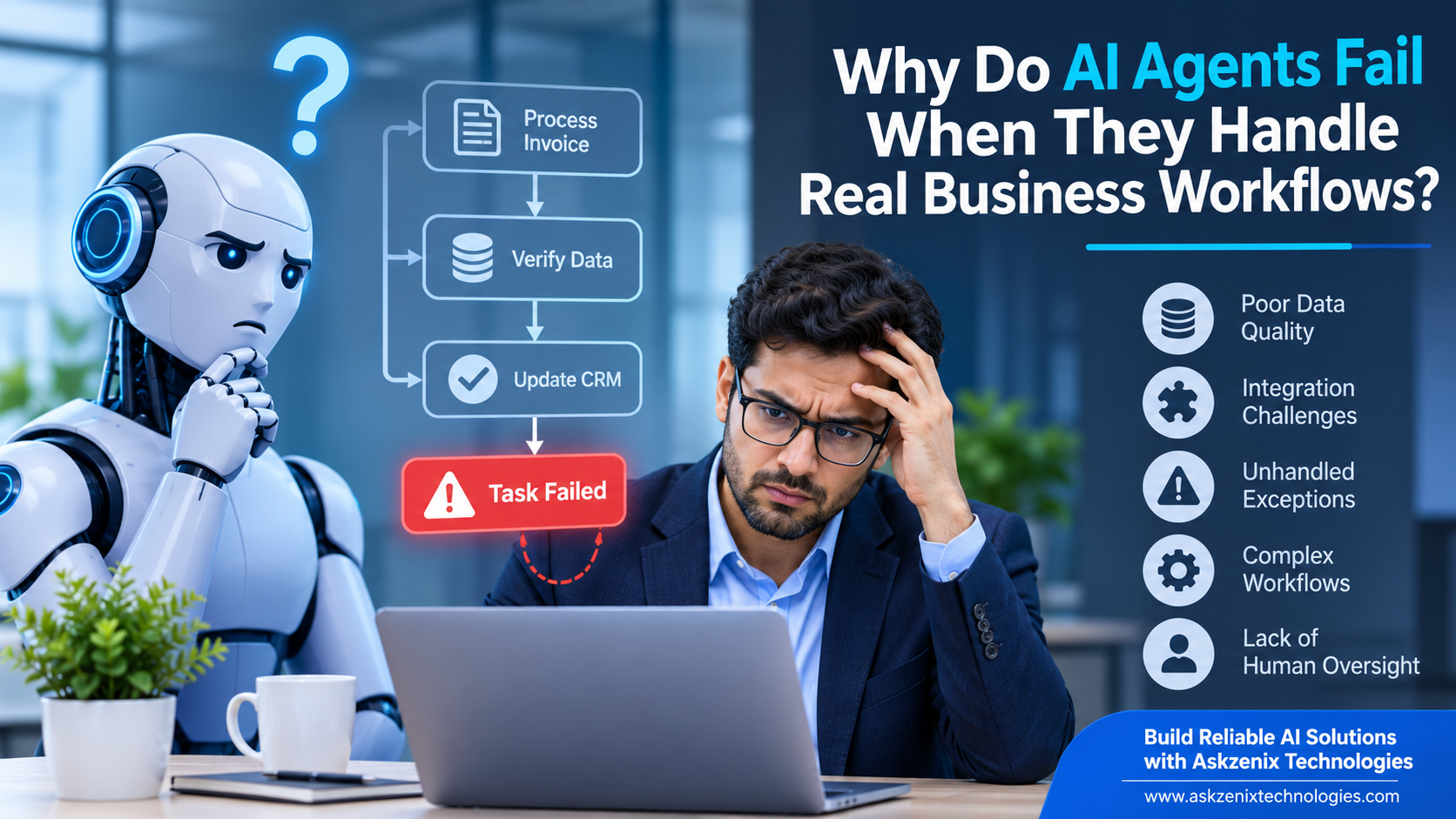
Why Do AI Agents Fail When They Handle Real Business Workflows?
AI agents are becoming an important part of business automation. Companies are using them to process documents, manage customer queries, update CRM records, generate reports, handle approvals, and automate repetitive operational tasks. However, moving an AI agent from a controlled testing environment into real business operations is not always successful.
Many businesses discover that an AI agent that performs well during demonstrations starts making mistakes when connected to actual business systems. It may misunderstand customer requests, retrieve incorrect information, fail to complete multi-step tasks, update the wrong records, or stop working when something unexpected happens.
So, why do AI agents fail when handling real business workflows?
The problem is rarely just the AI model. Most failures happen because of poor workflow design, unreliable data, insufficient system integration, missing business rules, and a lack of monitoring.
Understanding these challenges is essential for businesses planning to implement AI automation solutions.
Why AI Agents Struggle With Real Business Operations
An AI agent can understand instructions and make decisions based on available information. However, real business processes involve multiple systems, changing conditions, exceptions, approvals, and dependencies.
For example, consider an AI agent designed to process vendor invoices. It must extract invoice information, verify vendor details, compare purchase orders, check payment status, identify discrepancies, and send the invoice for approval.
Even if the AI extracts invoice details accurately, the workflow can still fail if the vendor information is outdated or the purchase order cannot be retrieved.
This highlights an important difference between AI demonstrations and production-ready AI automation. Real business workflows require more than intelligent responses. They require accuracy, consistency, system connectivity, and controlled execution.
Common Reasons AI Agents Fail in Business Workflows
1. Poor Data Quality Leads to Incorrect Decisions
AI agents depend on business data to understand situations and perform tasks. If the underlying data is incomplete, duplicated, outdated, or inconsistent, the agent may produce incorrect results.
For example, an AI-powered CRM agent may receive customer information from multiple sources. If the customer's contact details differ between the CRM, marketing platform, and support system, the agent may update the wrong record or create duplicate entries.
Data quality becomes even more important in financial processing, inventory management, customer onboarding, and enterprise operations.
Businesses should establish data validation rules, standardize information across systems, and implement mechanisms to identify missing or conflicting records before allowing AI agents to execute critical tasks.
2. AI Agents Cannot Handle Every Business Exception
Most business workflows look straightforward when everything works as expected. However, real operations frequently involve exceptions.
An invoice may contain missing information. A customer may request something outside the standard policy. A payment may fail even after an order is confirmed. An approval request may remain pending for several days.
AI agents often struggle when they encounter situations that were not included in their original instructions or workflow design.
For reliable AI workflow automation, businesses need clearly defined exception-handling mechanisms. The agent should know when to retry, when to request additional information, when to escalate an issue, and when human approval is necessary.
3. Weak Integration With Existing Business Systems
AI agents rarely operate independently. They need to communicate with applications such as CRM platforms, ERP software, accounting systems, databases, payment gateways, and internal business tools.
If these integrations are unreliable, the entire automation process can break.
For example, an AI sales agent may successfully identify a qualified lead but fail to update the CRM because of an API timeout or authentication issue. Similarly, an AI document processing agent may extract information correctly but fail to transfer it into the accounting system.
Businesses need reliable API integrations, proper authentication, structured data exchange, and error-handling mechanisms.
Custom AI agent development should consider the complete technology ecosystem rather than focusing only on the intelligence of the AI model.
4. Incorrect Tool Usage and Uncontrolled Actions
AI agents use tools to perform actions such as sending emails, updating databases, creating tickets, generating invoices, and retrieving customer information.
However, an agent may select the wrong tool, pass incorrect parameters, or execute an action without checking whether the required conditions are satisfied.
For example, an AI customer support agent might initiate a refund without properly verifying the transaction or checking the company's refund policy.
This creates operational and financial risks.
Businesses should implement permission-based tool access, validation before execution, transaction controls, and approval mechanisms for sensitive actions.
5. Multi-Step Workflows Increase the Possibility of Failure
A simple AI task may involve only one or two operations. Real business workflows often require multiple connected actions.
Consider an automated customer onboarding process:
- Collect customer information.
- Verify submitted documents.
- Validate customer details.
- Create a CRM record.
- Generate an account.
- Send a confirmation email.
- Notify the relevant department.
If one step fails, subsequent activities may become inconsistent.
For example, an account might be created even though document verification is incomplete.
To avoid this problem, AI agent systems need workflow orchestration, execution tracking, retry mechanisms, and clear dependencies between tasks. Each stage should have defined success and failure conditions.
6. Lack of Human Oversight
Businesses sometimes expect AI agents to operate completely independently after deployment. This approach can create serious problems, particularly in financial operations, customer management, compliance, and other sensitive workflows.
AI agents can misunderstand instructions, generate inaccurate information, or make decisions based on incomplete context.
Human-in-the-loop automation provides an additional layer of control.
For example, an AI agent can extract invoice information, verify it against purchase orders, and recommend an approval decision. However, invoices involving unusual amounts or mismatched information can be sent to a human reviewer.
The objective should not always be to eliminate human involvement. It should be to reduce repetitive work while keeping important decisions under appropriate control.
How Businesses Can Make AI Agents More Reliable
Successful AI agent implementation requires a combination of AI capabilities, software engineering, business process understanding, and continuous monitoring.
Businesses should begin by identifying workflows that have clearly defined inputs, outputs, and business rules. Automating an entire complex process immediately can make it difficult to identify the source of errors.
A better approach is to introduce AI agents into smaller workflow segments, validate their performance, and gradually expand their responsibilities.
Reliable implementations should also include structured API integrations, data validation, role-based permissions, exception handling, and execution logs.
Another important consideration is monitoring. Businesses should track task completion rates, error frequency, processing time, escalation rates, and the accuracy of agent decisions. These metrics help identify problems before they affect larger operations.
AI agents should also be tested against real-world scenarios, including incomplete data, API failures, duplicate requests, unexpected user instructions, and interrupted workflows.
How to Know Whether Your Business Is Ready for AI Agent Automation
Before investing in AI agent development, businesses should evaluate whether their existing processes are suitable for automation.
Some important questions include:
- Are business workflows properly documented?
- Is business data accurate and accessible?
- Can existing applications communicate through APIs?
- Are approval rules and operational policies clearly defined?
- Can the system identify and recover from failed tasks?
- Are sensitive actions protected by permission controls?
- Is there a process for human intervention?
- Can business teams monitor AI agent performance?
If these areas are not addressed, even an advanced AI model may struggle to deliver consistent business results.
Frequently Asked Questions About AI Agent Failures
Why do AI agents fail in production environments?
AI agents commonly fail in production because of poor data quality, unreliable integrations, unclear business rules, unexpected exceptions, and insufficient monitoring. Production environments are more complex than controlled testing environments.
Can AI agents handle complex business workflows?
Yes. AI agents can manage complex workflows involving multiple applications and decision-making steps. However, they require proper workflow orchestration, reliable integrations, validation mechanisms, and human oversight for critical decisions.
How can businesses reduce AI agent errors?
Businesses can reduce errors through data validation, structured API integrations, permission-based actions, automated testing, exception handling, human approvals, and continuous performance monitoring.
What is the difference between AI chatbots and AI agents?
AI chatbots primarily respond to user queries, while AI agents can interact with external tools and systems to complete tasks. For example, a chatbot can explain an invoice status, whereas an AI agent can retrieve invoice information, verify its status, and initiate an authorized workflow.
When should a business invest in custom AI agent development?
A business should consider custom AI agent development when repetitive workflows involve multiple applications, large volumes of data, frequent manual intervention, or operational bottlenecks that existing automation tools cannot adequately address.
Final Thoughts
AI agents have significant potential to transform business operations, but successful implementation requires more than connecting an AI model to business applications.
Real-world automation depends on reliable data, well-designed workflows, secure integrations, exception management, and continuous monitoring. Without these foundations, AI agents may perform impressively in demonstrations but struggle when exposed to actual business requirements.
Businesses planning to adopt AI automation should focus on building reliable, scalable, and business-oriented solutions rather than simply deploying AI agents to automate individual tasks.
Askzenix Technologies helps businesses explore custom AI development, intelligent workflow automation, software integration, and enterprise application development. Our approach focuses on connecting AI capabilities with practical business requirements to build solutions that support real operational needs.
If your business is planning to automate complex processes, investing in a properly engineered AI solution can help reduce manual effort, improve operational efficiency, and create a foundation for scalable digital transformation.