 Chat with us
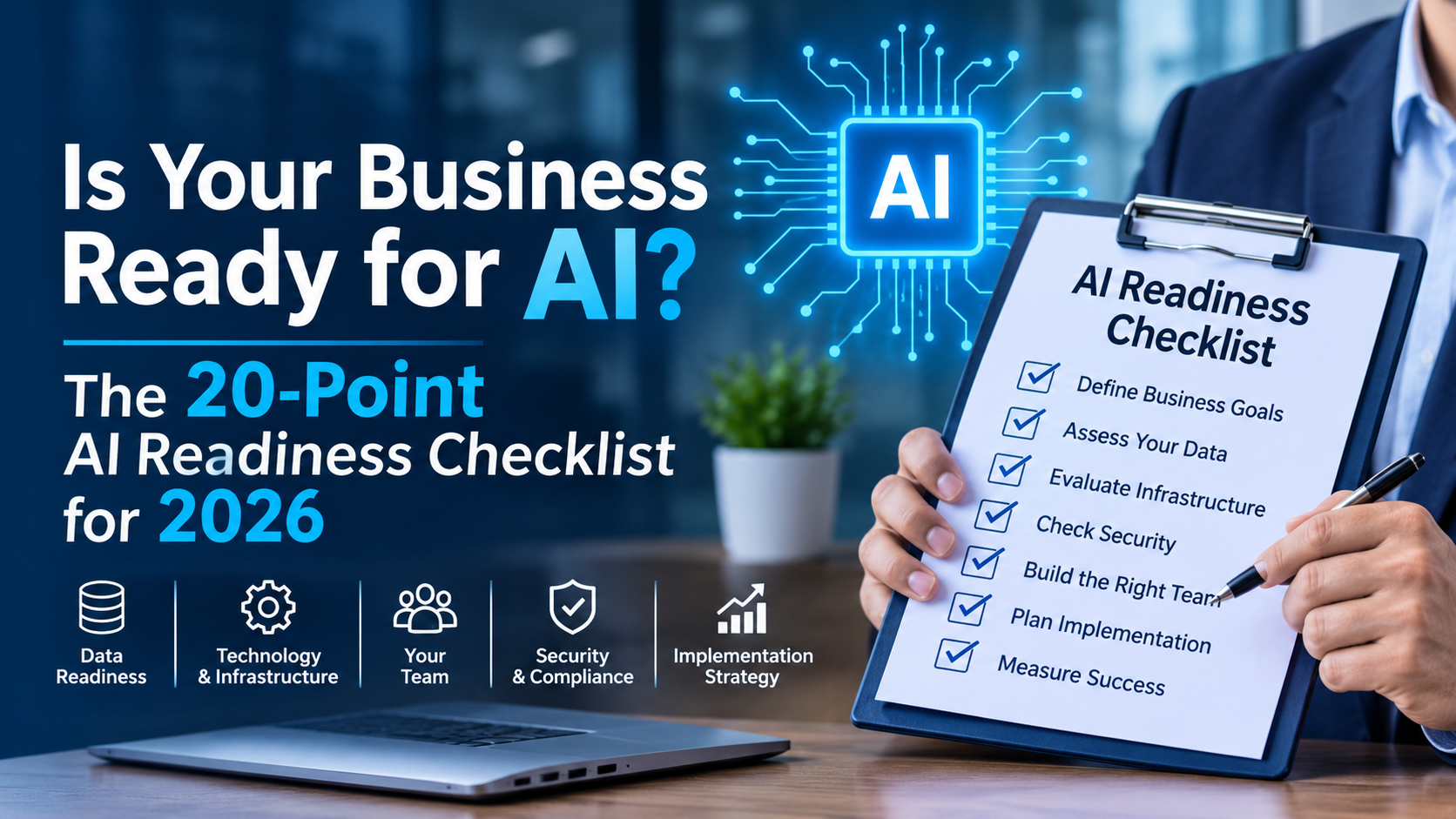
Is Your Business Ready for AI? The 20-Point AI Readiness Checklist for 2026
Artificial Intelligence is becoming an important part of how businesses operate, manage customers, analyze information, and make decisions. From automating repetitive tasks to predicting equipment failures and improving customer experiences, AI is creating new opportunities across industries.
However, adopting AI does not automatically mean a business will become more efficient or profitable. Many companies invest in AI tools without understanding whether their existing infrastructure, business processes, data, and teams are prepared to support them.
The real question is not whether your business should adopt AI, but whether it is ready to implement AI successfully.
Before investing in AI development, automation platforms, or machine learning solutions, businesses need to evaluate their current capabilities. An AI readiness assessment helps identify technical gaps, data limitations, operational challenges, and areas where AI can deliver measurable business value.
Here is a practical 20-point AI readiness checklist to help your business prepare for successful AI adoption in 2026.
Why AI Readiness Matters Before Implementation
AI solutions depend on more than algorithms and advanced technologies. They require reliable data, clearly defined business objectives, suitable infrastructure, and processes that can accommodate automation.
For example, a manufacturing company planning to implement AI-powered predictive maintenance needs historical equipment data, connected monitoring systems, and a process for responding to maintenance alerts.
Similarly, a business planning to automate customer support using AI needs access to accurate customer information, product documentation, and existing communication channels.
Without these foundations, even a well-developed AI solution may produce unreliable results or fail to deliver the expected return on investment.
Evaluating AI readiness before development helps businesses reduce implementation risks, control costs, and prioritize projects with the highest potential impact.
The 20-Point AI Readiness Checklist for 2026
Business Strategy and Objectives
1. Have You Identified a Clear Business Problem?
AI implementation should begin with a business challenge rather than a technology trend. Identify the problems that consume resources, delay operations, increase costs, or affect customer satisfaction.
Examples include manual invoice processing, delayed lead follow-ups, repetitive customer queries, production inefficiencies, and time-consuming data analysis.
2. Are Your AI Goals Clearly Defined?
Determine what you expect AI to achieve. Your objectives could include reducing operational costs, improving processing accuracy, increasing sales conversions, or reducing manual workloads.
Clearly defined goals make it easier to evaluate whether an AI project is delivering actual business value.
3. Have You Identified the Right Processes for Automation?
Not every business activity requires AI. Start by identifying repetitive, data-intensive, and time-consuming processes where automation can make a measurable difference.
For instance, AI can help process financial documents, classify customer inquiries, extract information from contracts, and identify unusual transaction patterns.
4. Do You Have a Realistic AI Budget?
AI development involves more than initial software costs. Businesses should consider data preparation, infrastructure, development, integration, security, maintenance, and ongoing model improvements.
A realistic budget helps prevent projects from stopping halfway because of unexpected expenses.
Data Readiness and Management
5. Is Your Business Data Organized?
Data is the foundation of most AI applications. If customer records, financial documents, inventory information, and operational data are scattered across disconnected systems, AI implementation becomes more complicated.
Evaluate where your business data is stored and whether it can be accessed reliably.
6. Is Your Data Accurate and Consistent?
Incomplete, duplicated, or outdated information can affect AI predictions and recommendations.
Review your existing databases and establish processes for data cleaning, validation, standardization, and regular updates.
7. Do You Have Enough Historical Data?
Machine learning applications often require historical data to identify patterns and generate predictions.
For example, predictive maintenance systems need equipment performance records, maintenance history, and operational data to identify potential failures.
The amount and quality of data required will depend on the specific AI use case.
8. Can Your AI Systems Access Business Data Securely?
AI applications frequently need to connect with CRM platforms, ERP systems, accounting software, databases, and third-party services.
Check whether your current systems provide secure APIs, suitable integration options, and controlled data access.
Technology and Infrastructure Readiness
9. Can Your Existing Infrastructure Support AI Applications?
Some AI applications require significant computing resources, storage capacity, and processing power.
Assess whether your existing cloud infrastructure, servers, databases, and network capabilities can support the proposed solution.
10. Are Your Existing Software Systems Integration-Ready?
Businesses often operate multiple software platforms that do not communicate effectively.
Before implementing AI, evaluate whether your CRM, ERP, websites, mobile applications, and internal tools can exchange information with new AI solutions.
Custom API development and backend improvements may be necessary.
11. Have You Evaluated the Right AI Technologies?
Different business problems require different technologies. Generative AI, machine learning, natural language processing, computer vision, and intelligent automation serve different purposes.
For example, computer vision can support manufacturing quality inspection, while natural language processing can help analyze customer conversations and documents.
Selecting technology based on business requirements is more effective than choosing tools simply because they are popular.
12. Do You Have a Plan for AI Security and Data Privacy?
AI applications may process confidential business information, customer records, financial documents, and employee data.
Establish access controls, encryption, data retention policies, secure integrations, and appropriate privacy safeguards.
Businesses should also evaluate third-party AI providers before sharing sensitive information.
Team and Operational Readiness
13. Does Your Team Understand How AI Will Change Their Work?
Employees need to understand how AI will support their responsibilities and where human involvement will remain necessary.
Clear communication and practical training help reduce resistance and encourage adoption.
14. Do You Have the Right Technical Expertise?
Successful AI implementation requires a combination of software development, data engineering, machine learning, cloud infrastructure, and integration expertise.
Depending on the project, businesses may need AI engineers, Python developers, data specialists, backend developers, and software testing professionals.
If these capabilities are unavailable internally, partnering with an experienced AI development company can help fill the technical gaps.
15. Are Your Business Processes Ready for AI Integration?
Automating an inefficient process does not necessarily make it better.
Review existing workflows and identify unnecessary approvals, duplicated activities, and process bottlenecks before introducing AI.
In many cases, improving the workflow first produces better automation results.
16. Have You Defined Human Oversight and Accountability?
AI should not operate without appropriate supervision, particularly when decisions affect finances, customers, compliance, or business operations.
Define which decisions AI can handle independently and which require human approval.
This creates accountability and helps businesses manage incorrect predictions or unexpected outcomes.
Implementation and Long-Term Readiness
17. Can You Start With a Small AI Pilot Project?
Instead of automating an entire business operation immediately, select one practical use case and test it through a pilot project.
For example, a real estate company could initially implement AI-powered lead qualification rather than automating its entire sales process.
A focused pilot helps validate technical feasibility, employee adoption, and expected business benefits.
18. Have You Defined How AI Performance Will Be Measured?
AI projects need measurable performance indicators.
Depending on the application, businesses can track processing time, prediction accuracy, manual effort reduced, error rates, customer response time, and cost savings.
These metrics help determine whether the solution is meeting business expectations.
19. Do You Have a Plan for Continuous Monitoring and Improvement?
AI performance can change as business data, customer behavior, and operational requirements evolve.
Establish a process for monitoring model accuracy, identifying errors, updating datasets, and improving system performance.
AI implementation should be treated as an ongoing process rather than a one-time development project.
20. Have You Evaluated the Long-Term Business Value of AI?
Before scaling an AI solution, understand whether it can deliver sustainable value.
Consider its impact on operational efficiency, customer experience, employee productivity, scalability, and overall business costs.
A successful AI initiative should solve an important business problem and provide measurable improvements over time.
How to Evaluate Your AI Readiness Score
Once you complete the checklist, assign a score to each point based on your current business capabilities.
- 0 – Not Ready: The capability is missing or has not been evaluated.
- 1 – Partially Ready: Some processes or resources are available, but improvements are required.
- 2 – Ready: The capability is established and suitable for AI implementation.
With 20 questions and a maximum score of 40, your business can use the following assessment as an initial indication of its AI readiness.
|
Score |
AI Readiness Level |
What It Means |
|
0–15 |
Early Stage |
Focus on data, processes, and infrastructure |
|
16–25 |
Developing |
Address technical and operational gaps |
|
26–33 |
Nearly Ready |
Start with a focused AI pilot |
|
34–40 |
AI Ready |
Consider implementing and scaling AI solutions |
This scoring method is a practical self-assessment, not a formal certification or guarantee of successful AI implementation. The importance of individual factors will also vary depending on the proposed AI application.
Common Mistakes Businesses Make Before Adopting AI
Even businesses with modern technology infrastructure can struggle with AI implementation because of avoidable planning mistakes.
One common mistake is investing in AI without identifying a specific business problem. Another is expecting AI to produce accurate results from incomplete or inconsistent data.
Some companies also underestimate integration requirements, overlook employee training, or fail to establish performance metrics before deployment.
Choosing an AI platform without considering scalability, data privacy, and long-term maintenance can create additional costs.
The better approach is to start with business requirements, evaluate existing capabilities, and develop an implementation roadmap before committing to a large-scale AI investment.
How an AI Development Partner Can Help Your Business
Preparing for AI adoption often requires expertise across multiple technology areas. Businesses may need support with data engineering, custom software development, machine learning, cloud infrastructure, API integration, and AI testing.
Working with an experienced AI development company can help organizations identify suitable use cases, evaluate technical readiness, build proof-of-concept solutions, and integrate AI into existing business applications.
At Askzenix Technologies, we help businesses explore practical AI opportunities through custom AI development, intelligent workflow automation, machine learning, and business process optimization.
Whether you want to automate financial document processing, improve manufacturing operations, develop AI-powered business applications, or integrate intelligent automation into existing software, the right implementation strategy starts with understanding your business requirements.
Final Thoughts
AI readiness is not simply about having access to the latest AI tools. It is about having the right data, technology, people, processes, and business objectives to use those tools effectively.
The 20-point AI readiness checklist provides a starting point for identifying gaps and understanding where your organization stands before investing in AI development.
You do not need to transform every business operation at once. Identify one high-impact problem, validate the opportunity through a pilot project, measure the results, and expand gradually.
Is your business planning to adopt AI in 2026? Start with an AI readiness assessment and identify the opportunities that can deliver measurable business value.
Connect with Askzenix Technologies to discuss your AI development requirements and explore the right AI solution for your business.