 Chat with us
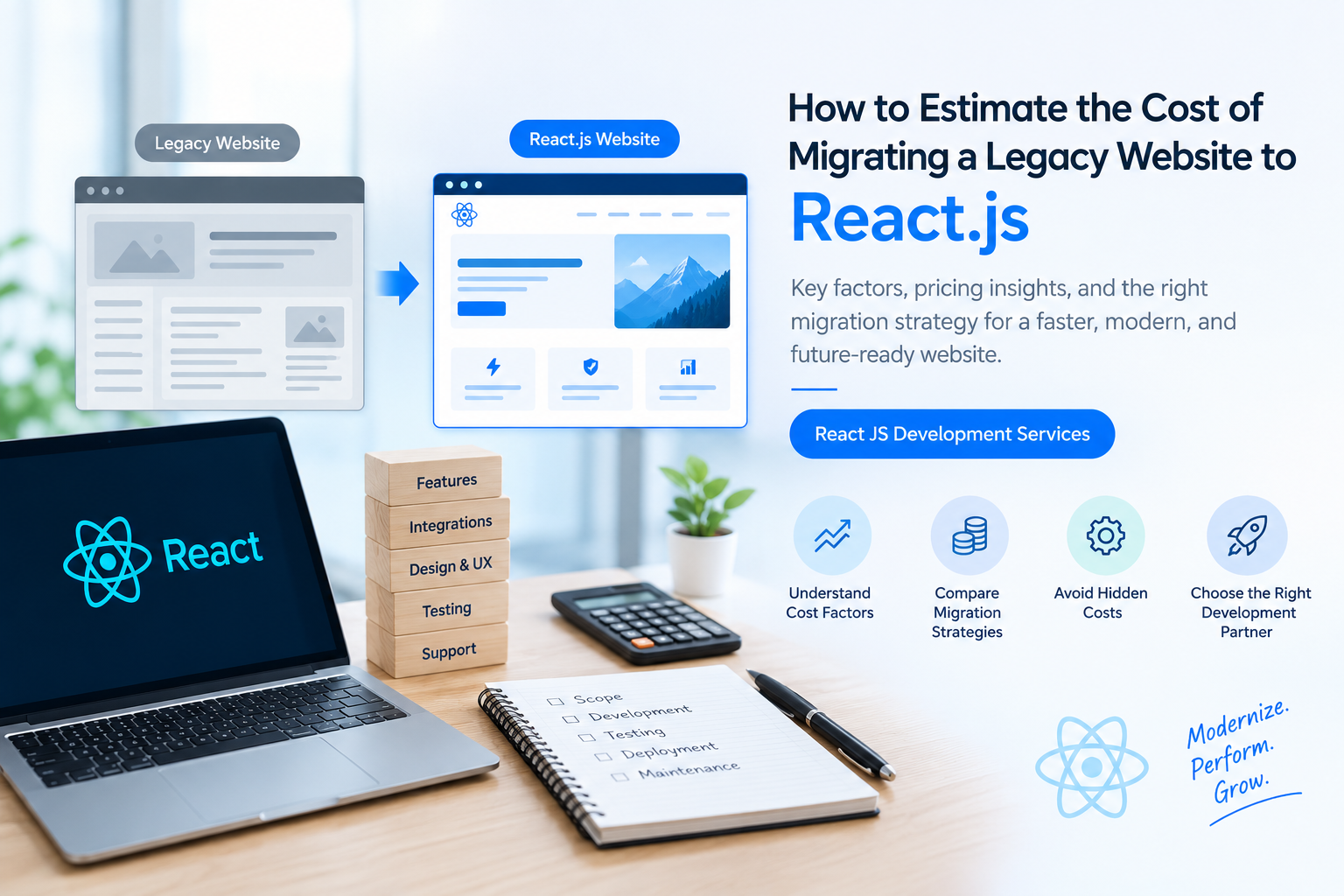
How to Estimate the Cost of Migrating a Legacy Website to React.js
Migrating a legacy website to React.js can improve user experience, maintainability, and frontend performance, but the overall cost depends on more than the technology itself. Existing code quality, application complexity, third-party integrations, data requirements, and business continuity all influence the migration budget.
For businesses running outdated websites built with jQuery, older JavaScript frameworks, or traditional server-rendered templates, understanding these costs before starting a project helps prevent budget overruns and unnecessary redevelopment.
Professional React JS development services can help businesses evaluate their existing website, select an appropriate migration strategy, and modernize the frontend while preserving essential business functionality.
What Determines the Cost of React.js Website Migration?
There is no universal price for migrating a legacy website to React.js. A relatively simple corporate website requires a different level of effort than a complex customer portal, eCommerce platform, or business application.
The following factors have the greatest impact on migration costs.
Complexity of the Existing Website
The number of pages alone does not determine migration effort. A website with 30 static pages may be easier to migrate than a platform with 10 pages containing complex dashboards, dynamic forms, and interactive workflows.
Developers need to assess existing components, JavaScript dependencies, reusable templates, and application logic before estimating the work involved.
Legacy code that is poorly documented or tightly coupled to the existing frontend can require additional investigation and refactoring.
UI Redesign and Component Development
React.js encourages reusable UI components, allowing developers to build consistent interfaces that are easier to maintain.
However, migrating an existing website does not automatically require a complete redesign. Retaining the current interface can reduce development effort, while introducing a new design system, responsive layouts, accessibility improvements, and interactive components increases the scope.
Businesses should decide whether the objective is a straightforward frontend migration or a broader user experience transformation.
Backend and Third-Party Integrations
A React.js migration does not necessarily require replacing the backend. Existing APIs and server-side systems may continue to handle authentication, business rules, databases, and transactions.
Costs increase when the migration requires new APIs, authentication changes, CRM or ERP integrations, payment gateway updates, or modifications to legacy backend services.
An experienced development team can identify which systems should remain unchanged and which require modification, helping avoid unnecessary redevelopment.
Which Migration Strategy Is More Cost-Effective?
Choosing the right migration approach can significantly affect the total project cost.
Incremental migration replaces selected pages or components while the existing website continues operating. It can reduce disruption and spread costs across multiple releases. This approach works well when the current application is stable and the business wants to modernize gradually.
Full frontend migration replaces the existing frontend with a React.js application in a coordinated project. It may be suitable when the current interface is difficult to maintain or when major product changes are planned.
Migration with backend modernization involves changes to both the frontend and backend architecture. This option generally requires a larger budget but may be appropriate when legacy APIs, security limitations, or business logic prevent future development.
The most cost-effective choice is the one that addresses the actual technical limitations without replacing systems that already work reliably.
Hidden Costs Businesses Should Consider
Development is only one part of the migration budget. Businesses should also account for testing, deployment, monitoring, and post-launch support.
Important cost considerations include:
- SEO preservation: Maintaining URL structures where possible, implementing redirects when necessary, and preserving metadata, canonical tags, and structured data.
- Functional testing: Verifying forms, authentication, navigation, checkout processes, and integrations across supported browsers and devices.
- Performance optimization: Measuring Core Web Vitals, managing JavaScript bundle sizes, and selecting appropriate rendering strategies.
- Accessibility: Ensuring that interactive components support keyboard navigation and assistive technologies.
- Deployment and maintenance: Preparing staging environments, monitoring production issues, and planning ongoing updates.
Ignoring these requirements can make an apparently inexpensive migration more expensive after launch.
How to Get an Accurate React.js Migration Estimate
Start by documenting the existing website's functionality, integrations, traffic requirements, and known technical problems. Identify which features must remain unchanged and which should be improved.
Next, request a technical audit covering frontend architecture, backend dependencies, SEO risks, and testing requirements. Ask the development team to separate essential migration work from optional enhancements.
A clear proposal should specify deliverables, assumptions, exclusions, milestones, testing responsibilities, and post-launch support. This makes it easier to compare development companies on scope and quality rather than price alone.
Businesses evaluating React JS development services should also assess the team's experience with legacy applications, API integration, performance optimization, and production migrations.
Conclusion
The cost of migrating a legacy website to React.js depends on application complexity, existing code quality, integration requirements, redesign decisions, and testing needs. A small website may require a modest investment, while an enterprise application with extensive dependencies can demand a much larger budget.
The best starting point is a technical assessment that identifies the necessary changes and establishes a realistic project scope.
Askzenix Technologies provides software development expertise for businesses planning custom web applications, frontend modernization, and scalable digital platforms. If your existing website has become difficult to maintain or extend, professional React JS development services can help you plan a migration aligned with your technical requirements and business goals.