 Chat with us
What Is Responsible AI and Why Does It Matter for Modern Businesses?
Artificial Intelligence is transforming how businesses operate, make decisions, and interact with customers. From automated customer support and financial document processing to predictive analytics and AI-powered business applications, organizations are increasingly adopting AI to improve productivity and efficiency.
However, AI adoption also introduces concerns related to data privacy, security, algorithmic bias, inaccurate decisions, and accountability. Businesses need to ensure that their AI applications are not only intelligent but also safe, fair, and reliable.
This is where Responsible AI becomes important. It provides a set of principles and practices that help organizations develop, deploy, and manage artificial intelligence ethically while maintaining business objectives and customer trust.
What Is Responsible AI?
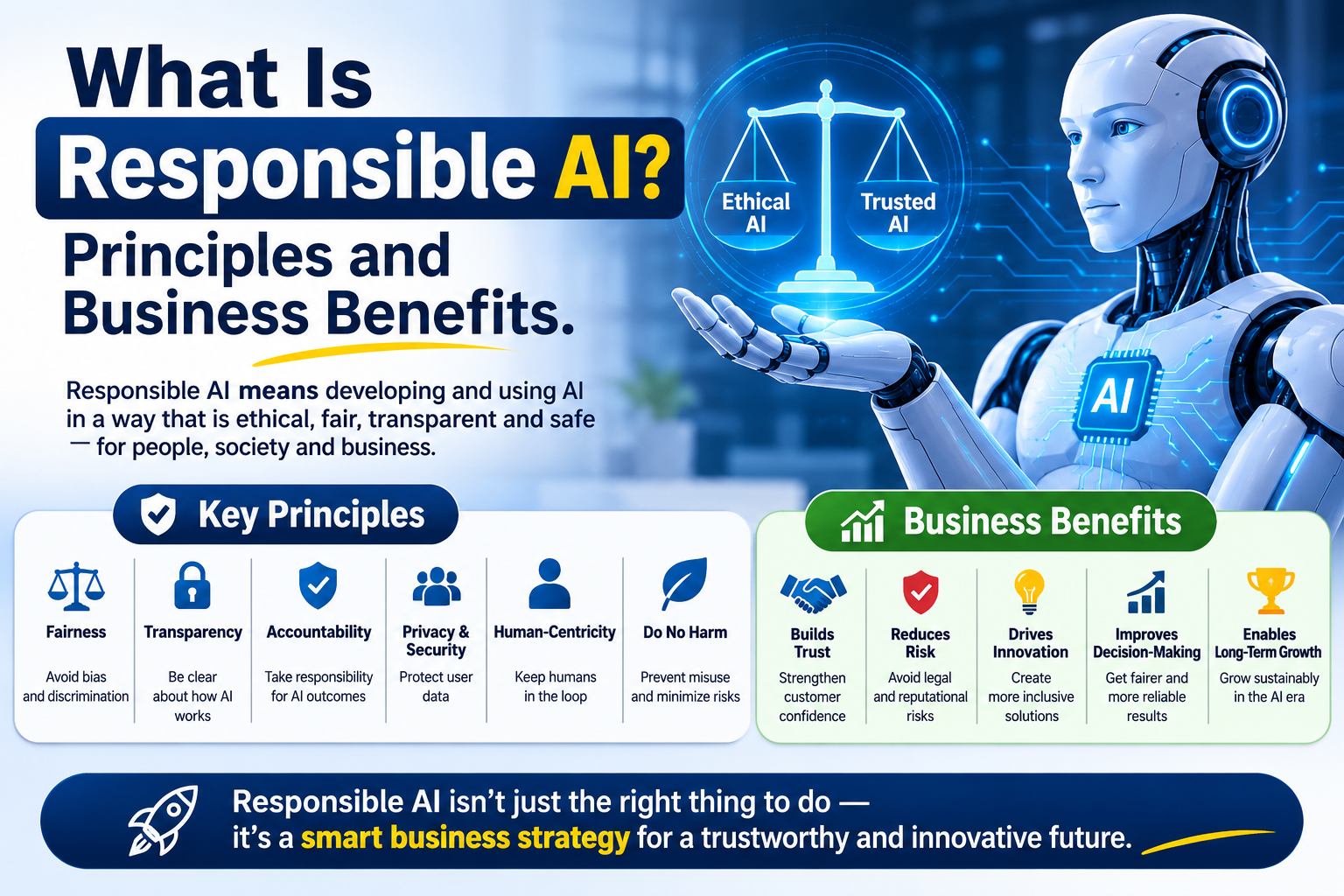
Responsible AI refers to the practices, guidelines, and technical measures used to ensure that artificial intelligence systems operate fairly, transparently, securely, and accountably.
It considers the complete AI lifecycle, including data collection, model development, testing, deployment, and continuous monitoring.
For example, consider a company using an AI-powered recruitment platform to shortlist candidates. If the AI model is trained using biased historical recruitment data, it may unintentionally favor certain applicants over others.
A responsible AI approach involves evaluating training data, testing model outputs for bias, protecting candidate information, and allowing human recruiters to review important recommendations.
The objective is to ensure that AI systems deliver business value without creating unnecessary risks for individuals or organizations.
Why Is Responsible AI Important for Businesses?
As companies integrate AI into their operations, responsible implementation becomes essential for maintaining trust and reducing business risks.
Building customer trust: Customers expect AI applications to provide accurate information and protect their personal data. Transparency about AI usage helps organizations establish stronger customer relationships.
Reducing operational risks: AI models can generate incorrect predictions or misleading information. Testing and monitoring help identify potential issues before they affect business operations.
Protecting sensitive information: AI applications frequently process customer records, financial documents, and confidential business data. Appropriate security controls help prevent unauthorized access and data exposure.
Preventing algorithmic bias: AI models can reproduce biases present in their training datasets. Regular assessments help businesses identify and reduce unfair outcomes.
Supporting regulatory compliance: Responsible AI practices help organizations understand applicable AI regulations, data protection requirements, and industry-specific obligations.
Key Principles of Responsible AI
Fairness: AI systems should avoid discriminatory outcomes. Businesses should evaluate training datasets and test models across relevant user groups.
Transparency: Organizations should understand how their AI systems operate and communicate relevant information about their capabilities and limitations.
Accountability: Clear responsibilities should exist for developing, approving, monitoring, and maintaining AI applications.
Privacy and Security: Sensitive information must be protected through encryption, access controls, secure data storage, and appropriate privacy practices.
Reliability: AI applications should produce consistent and dependable results under expected operating conditions.
Human Oversight: Important AI-generated decisions should have appropriate human review mechanisms, particularly when they involve financial, legal, or personal consequences.
How Can Businesses Implement Responsible AI?
Implementing responsible AI requires collaboration between business leaders, developers, data teams, and quality assurance professionals.
Organizations can begin by establishing clear AI usage policies that define acceptable practices, data handling requirements, security standards, and employee responsibilities.
Data quality should be another priority. Businesses must validate datasets, identify missing or inaccurate information, and assess potential biases before training AI models.
Before deployment, AI applications should undergo comprehensive testing for accuracy, security, fairness, performance, and reliability. Generative AI applications also require assessments for hallucinations, prompt injection, and confidential data exposure.
Human approval mechanisms should be introduced wherever automated actions could significantly affect business operations or customers.
Finally, organizations should continuously monitor AI performance, maintain relevant documentation, and update models when business requirements or data patterns change.
Responsible AI Frameworks and Standards
Businesses can use established frameworks to develop structured responsible AI practices.
- NIST AI Risk Management Framework: Helps organizations identify, measure, and manage AI-related risks through Govern, Map, Measure, and Manage functions.
- ISO/IEC 42001: Provides requirements for establishing and continually improving an Artificial Intelligence Management System.
- OECD AI Principles: Promote trustworthy AI based on transparency, accountability, robustness, and respect for human rights.
- EU AI Act: Establishes a risk-based regulatory framework for AI systems operating within its scope.
These frameworks help organizations establish appropriate policies and controls based on their AI applications and business requirements.
Responsible AI in Generative AI and AI Agents
Generative AI and autonomous AI agents are creating additional responsibilities for businesses.
AI agents can interact with enterprise applications, retrieve information, process documents, and execute business workflows. Without appropriate controls, they may access unauthorized information or initiate incorrect actions.
Businesses should introduce permission-based access, output validation, activity logging, and human approval for sensitive operations.
For generative AI applications, organizations should also address hallucinations, prompt injection, and potential data leakage.
Responsible AI practices help ensure that business automation remains secure, controlled, and aligned with organizational objectives.
Common Challenges in Responsible AI Adoption
Organizations often struggle with limited AI expertise, poor data quality, unclear ownership, and evolving regulatory requirements.
Another growing concern is shadow AI, where employees use external AI tools without organizational approval. This can expose confidential information and create security risks.
Businesses can address these challenges through employee awareness, documented AI policies, regular risk assessments, and continuous technical monitoring.
Starting with a few well-defined AI applications can also help organizations establish responsible practices before expanding AI adoption.
Conclusion
Responsible AI is becoming an essential part of modern business technology. Organizations must look beyond automation and model performance to ensure that their AI applications remain fair, transparent, secure, and reliable.
By combining proper governance, quality data management, software testing, security controls, and human oversight, businesses can reduce AI-related risks and build trustworthy solutions.
At Askzenix Technologies, we believe successful AI adoption requires more than developing intelligent applications. It involves building secure, scalable, and reliable solutions that address real business challenges. Whether your organization is exploring generative AI, machine learning, or AI-powered business automation, responsible implementation can help create sustainable long-term value