 Chat with us
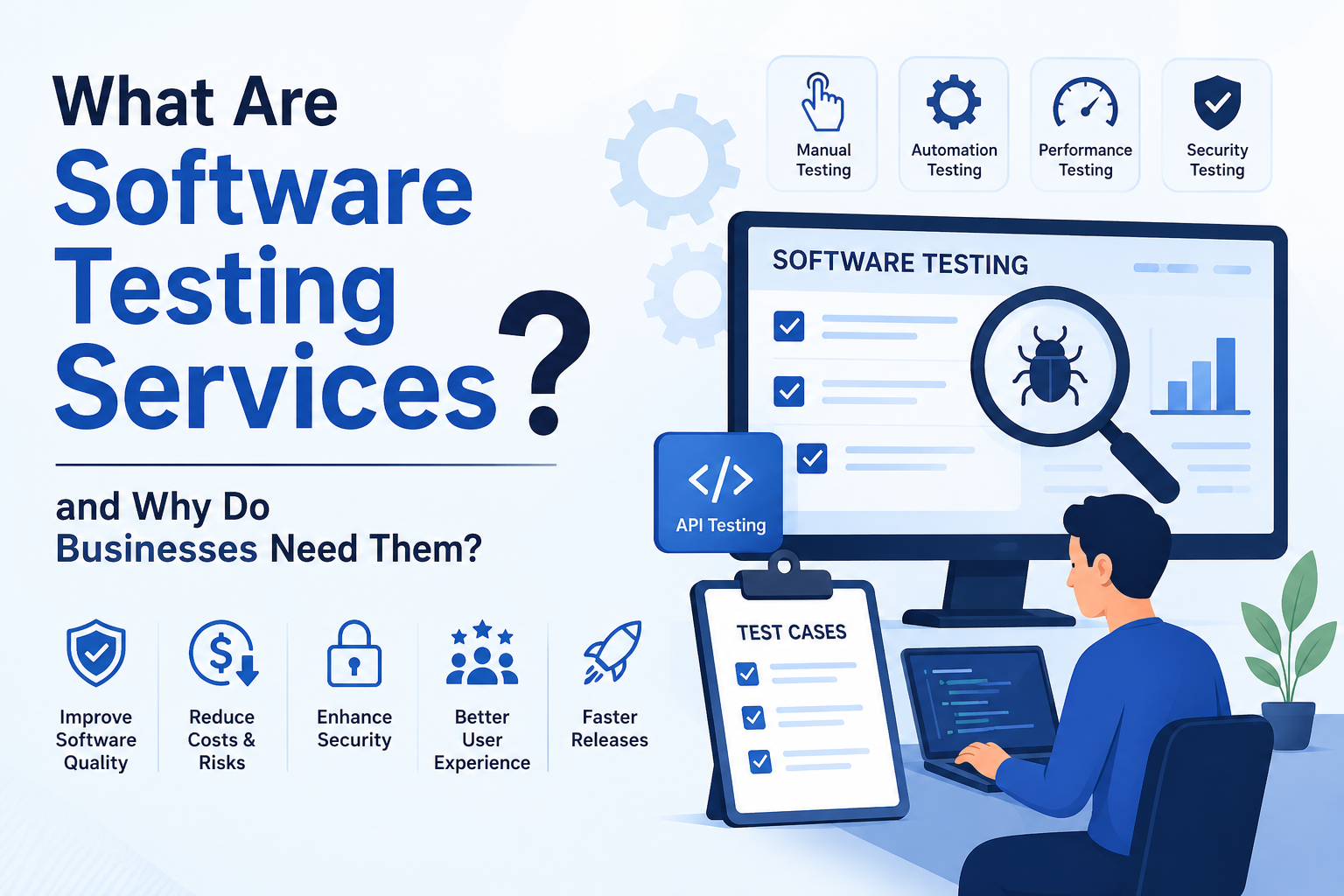
What Are Software Testing Services and Why Do Businesses Need Them?
Software Testing Services help businesses identify bugs, improve application performance, protect data, and deliver reliable digital products. As companies increasingly depend on websites, mobile applications, SaaS platforms, and enterprise software, professional testing has become an important part of the software development lifecycle.
A software product may appear complete but still contain functional errors, security vulnerabilities, compatibility issues, or performance problems. Software testing helps identify these risks before they affect customers and business operations.
What Are Software Testing Services?
Software Testing Services are professional quality assurance services designed to evaluate whether an application meets its functional, technical, security, usability, and business requirements.
Testing professionals examine software from multiple perspectives to identify defects and potential risks. Depending on the project, testing may include manual testing, automation testing, functional testing, regression testing, API testing, performance testing, security testing, usability testing, mobile testing, and cross-browser testing.
The goal of software testing is not simply to find bugs. A comprehensive testing process helps ensure that an application is reliable, secure, scalable, user-friendly, and ready for real-world usage.
Why Do Businesses Need Software Testing?
1. Improve Software Quality
Application quality directly influences customer satisfaction. Broken features, application crashes, incorrect calculations, slow pages, and unexpected behavior can negatively affect the user experience.
Professional testing helps identify these issues before software is released to customers.
2. Reduce Development Costs
Finding and fixing defects at an early stage can help businesses avoid expensive corrections after deployment. Continuous testing allows development teams to identify problems throughout the software development lifecycle.
Early defect detection can also reduce maintenance efforts and the risk of major production failures.
3. Improve Application Security
Security vulnerabilities can expose sensitive customer and business information. Security testing helps identify weaknesses that could potentially be exploited.
For applications handling payments, personal information, financial data, or confidential business information, security testing should be an important part of the overall QA strategy.
4. Deliver Better Customer Experiences
Modern users expect digital products to be fast, reliable, responsive, and easy to use.
Software testing evaluates applications across different devices, browsers, operating systems, and screen sizes. This helps businesses provide a consistent experience to their customers.
5. Support Faster Software Releases
Businesses regularly introduce new features, updates, and improvements. Testing every feature manually after every update can become time-consuming for large applications.
Automation testing can execute repetitive test cases efficiently and provide faster feedback. This makes automated testing particularly useful for Agile development and CI/CD environments.
Types of Software Testing Services
Businesses can use different testing methodologies depending on their application, technology stack, industry, and business objectives.
Manual Testing
Manual testing is performed by QA professionals without relying entirely on automated scripts. Testers interact with the application and evaluate its functionality, usability, workflows, and behavior.
Manual testing is particularly valuable for exploratory testing, usability testing, and scenarios where human judgment is important.
Automation Testing
Automation testing uses specialized tools and frameworks to execute predefined test cases automatically.
It is useful for repetitive testing, regression testing, large applications, and projects requiring frequent releases. Automation can improve testing efficiency while providing repeatable results.
Functional Testing
Functional testing verifies whether individual features work according to business and technical requirements.
For example, testers may verify login, registration, search, checkout, payment, form submission, and account management functionality.
Regression Testing
Regression testing checks whether existing functionality continues to work after new code, features, integrations, or configuration changes are introduced.
It is particularly important for applications that receive frequent updates.
Performance Testing
Performance testing evaluates how an application behaves under different workloads.
It can help identify slow response times, performance bottlenecks, scalability limitations, and application behavior under heavy traffic.
API Testing
API testing validates communication between different software components. It checks responses, data accuracy, authentication, error handling, and API performance.
API testing is especially important for modern applications that rely on multiple services and third-party integrations.
Mobile Application Testing
Mobile testing evaluates applications across different smartphones, tablets, operating systems, screen sizes, network conditions, and device configurations.
It helps businesses deliver consistent Android and iOS experiences.
Cross-Browser Testing
Cross-browser testing checks whether websites and web applications function correctly across commonly used browsers and browser versions.
This helps prevent browser-specific compatibility issues from affecting users.
Manual Testing vs Automation Testing
Manual and automation testing should not necessarily be viewed as competing approaches.
Manual testing is valuable when human observation, exploratory testing, usability evaluation, and changing test scenarios are involved. Automation testing is highly effective for repetitive, predictable, and frequently executed test cases.
A strong QA strategy often combines both approaches based on project requirements.
Benefits of Working With a Software Testing Company
Working with an experienced software testing company can provide businesses with dedicated QA expertise without requiring them to build an entire internal testing team.
Key benefits include:
- Access to experienced QA professionals
- Structured testing methodologies
- Manual and automation testing capabilities
- Better test coverage
- Faster identification of defects
- Support for Agile and DevOps workflows
- Reduced production risks
- Testing across multiple devices and platforms
- Improved application reliability
- Scalable testing support during product growth
How Software Testing Fits Into the Development Lifecycle
Testing should not be treated as an activity that begins only after development is completed.
Modern software teams increasingly integrate testing throughout the development lifecycle. Requirements can be reviewed for testability, developers can perform unit testing, QA teams can conduct functional and integration testing, and automated tests can be integrated into CI/CD pipelines.
This approach allows businesses to identify issues earlier and continuously monitor software quality.
Why Choose Askzenix Technologies for Software Testing Services?
Askzenix Technologies provides software quality assurance and testing support for businesses developing web applications, mobile applications, enterprise platforms, and custom software solutions.
A project-specific testing strategy can combine manual testing, automation testing, functional testing, regression testing, API testing, performance testing, and other QA practices based on the application's requirements.
The testing approach should be aligned with the project's technology, release cycle, user expectations, security requirements, and business objectives rather than following a one-size-fits-all process.
Frequently Asked Questions
What are software testing services?
Software Testing Services involve evaluating software applications to identify defects and verify functionality, performance, security, usability, compatibility, and reliability.
Why is software testing important for businesses?
Software testing helps businesses reduce defects, improve application quality, protect users, enhance customer experience, and reduce the risk of costly production issues.
Is automation testing better than manual testing?
Neither approach is universally better. Automation is effective for repetitive and regression testing, while manual testing is valuable for exploratory testing, usability evaluation, and scenarios requiring human judgment. Many projects benefit from using both.
When should software testing start?
Testing should ideally begin early in the software development lifecycle. Requirements, designs, code, integrations, and completed features can all be evaluated at different stages.
Can software testing be outsourced?
Yes. Businesses can outsource software testing to specialized QA companies to access testing expertise, tools, and scalable resources without building a large internal QA team.
Conclusion
Software Testing Services are an important part of delivering reliable and high-quality digital products. From manual and automation testing to performance, API, security, mobile, and regression testing, businesses can use different testing approaches to identify risks and improve application quality.
For companies developing new software or maintaining existing applications, investing in a structured QA strategy can help reduce defects, improve user satisfaction, support faster releases, and increase confidence in every software deployment.
Askzenix Technologies can help businesses implement software testing and quality assurance strategies aligned with their application requirements, development methodology, and business goals