 Chat with us
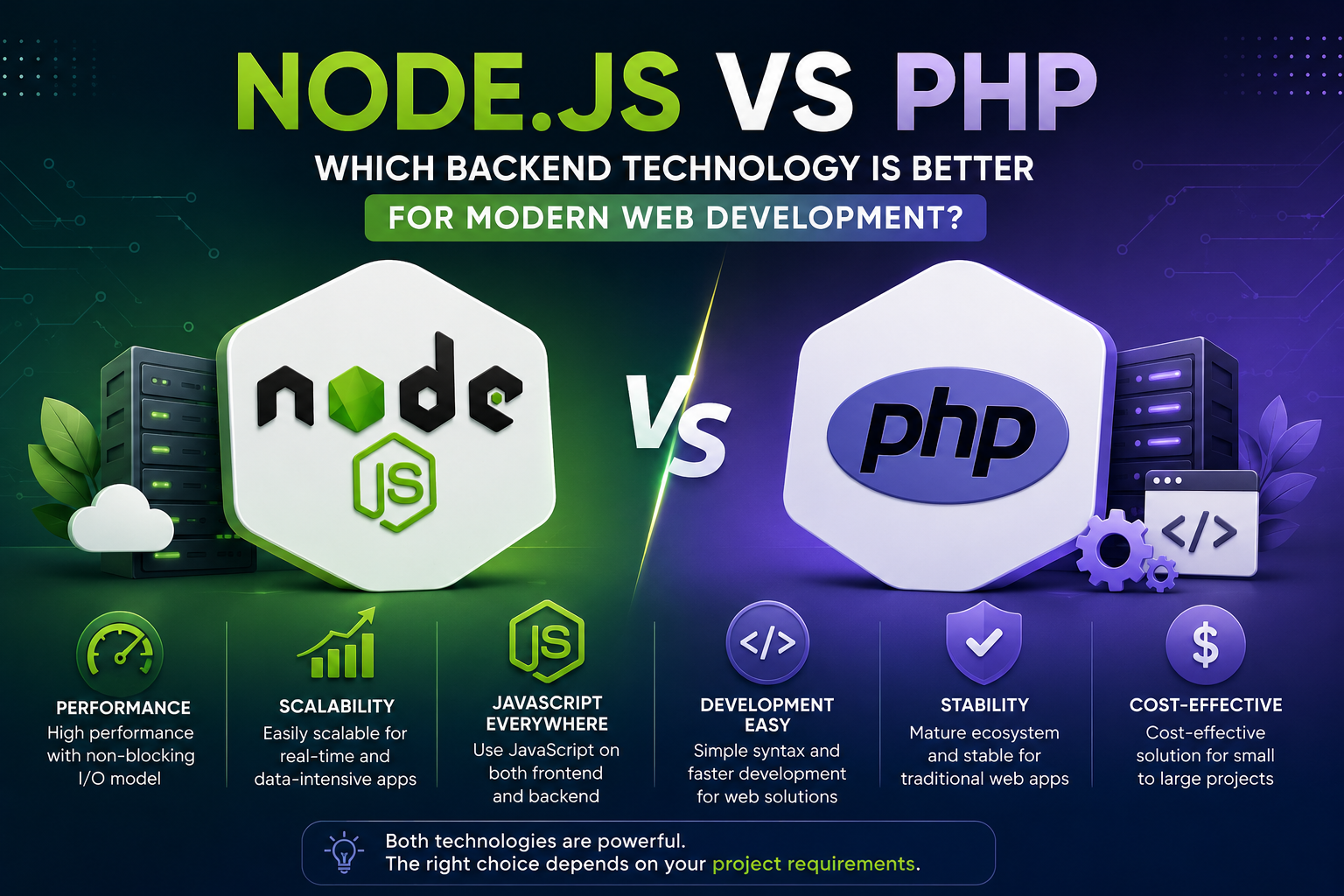
Node.js vs PHP: Which Backend Technology Is Better for Modern Web Development?
Node.js vs PHP is a common comparison for businesses planning a new website, web application, SaaS platform, or custom software solution. Both technologies have mature ecosystems and can power reliable applications, but they use different approaches to backend development.
PHP has been a popular server-side technology for decades and remains widely used for websites, eCommerce platforms, and content management systems. Node.js has become increasingly popular for modern applications that require scalable APIs, real-time communication, and fast development.
The right choice depends on your application's requirements, expected traffic, development team, budget, and long-term business goals.
What Is Node.js?
Node.js is a JavaScript runtime that allows developers to use JavaScript for server-side development. Its event-driven, non-blocking architecture makes it particularly suitable for applications that handle multiple concurrent requests.
Node.js is commonly used for:
- REST and GraphQL APIs
- SaaS platforms
- Real-time applications
- E-commerce applications
- AI-powered applications
- Microservices
- Enterprise web applications
Businesses often choose Node.js development services when scalability, performance, and real-time functionality are important.
What Is PHP?
PHP is a server-side scripting language designed primarily for web development. It has a mature ecosystem, extensive documentation, and a large developer community.
PHP is commonly used for:
- Business websites
- E-commerce platforms
- Content management systems
- Customer portals
- Enterprise applications
- Custom web applications
Modern PHP frameworks such as Laravel provide advanced tools for developing secure and scalable web applications.
Node.js vs PHP: Key Differences
|
Factor |
Node.js |
PHP |
|
Language |
JavaScript |
PHP |
|
Architecture |
Event-driven, non-blocking |
Request-based |
|
Real-Time Applications |
Excellent |
Possible with additional technologies |
|
API Development |
Excellent |
Excellent |
|
Scalability |
Excellent with proper architecture |
Excellent with proper architecture |
|
Best Use Cases |
APIs, SaaS, real-time applications |
Websites, CMS, eCommerce, web applications |
|
Cloud Deployment |
Strong |
Strong |
|
Ecosystem |
npm |
Composer and PHP ecosystem |
Node.js vs PHP: Performance
Performance depends on several factors, including application architecture, database design, caching, server configuration, and code quality.
Node.js can perform particularly well for I/O-intensive applications because its non-blocking architecture allows it to handle multiple operations efficiently.
Modern PHP has also improved considerably. With current PHP versions, appropriate caching, optimized databases, and frameworks such as Laravel, PHP applications can deliver excellent performance.
For highly concurrent and real-time workloads, Node.js can have an advantage. However, both technologies can deliver strong performance when properly engineered.
Scalability
Scalability is critical for businesses expecting their user base and transaction volume to grow.
Node.js supports horizontal scaling, load balancing, microservices, containers, and cloud-native architectures. This makes it a strong choice for applications expected to handle large numbers of concurrent connections.
PHP applications can also scale effectively using caching, load balancing, database optimization, containerization, and distributed infrastructure.
Both technologies can scale successfully. The better option depends on your application architecture and business requirements.
Development Speed
Node.js allows developers to use JavaScript for both frontend and backend development. This can simplify collaboration and help teams work with a unified technology stack.
PHP also supports rapid development, particularly when using Laravel. Laravel provides tools for routing, authentication, database management, queues, testing, and application structure.
The development speed ultimately depends on the team's experience and the complexity of the project.
Real-Time Application Development
Real-time functionality is an area where Node.js is particularly effective.
Node.js can be used to build:
- Live chat applications
- Real-time notifications
- Collaboration platforms
- Live dashboards
- Delivery tracking systems
- Online gaming applications
- Real-time monitoring platforms
PHP can also support real-time functionality, but Node.js is often a natural fit for applications where persistent connections and frequent data updates are central to the user experience.
For real-time applications, Node.js is generally the stronger choice.
Security
Neither Node.js nor PHP is automatically secure. Application security depends on development practices, infrastructure configuration, dependency management, authentication, and ongoing maintenance.
A professional development team should implement:
- Secure authentication
- Role-based access control
- Input validation
- Data encryption
- API security
- Rate limiting
- Dependency updates
- Security testing
- Secure database practices
Both Node.js and PHP can be used to develop secure applications when appropriate security practices are followed.
Development Cost
The cost of development depends on project complexity, developer expertise, integrations, architecture, infrastructure, and maintenance requirements.
PHP can be cost-effective because of its mature ecosystem and large developer community. Node.js can also reduce development effort when JavaScript is used across both frontend and backend.
Businesses should evaluate total cost of ownership rather than choosing a technology solely because its initial development cost is lower.
Node.js vs PHP: Which Should Your Business Choose?
Choose Node.js if you need:
- Real-time communication
- High concurrency
- API-first architecture
- Microservices
- SaaS development
- AI integrations
- Cloud-native applications
- Fast and scalable backend services
Choose PHP if you need:
- Content-driven websites
- E-commerce platforms
- CMS-based solutions
- Laravel applications
- Business websites
- Rapid web application development
- A mature PHP ecosystem
There is no universal winner. The right technology depends on your business requirements and product roadmap.
Why Choose Askzenix Technologies for Node.js Development?
At Askzenix Technologies, we provide custom Node.js development services for startups, SMBs, and enterprises. Our expertise includes scalable web applications, APIs, SaaS platforms, AI integrations, enterprise software, and cloud-based solutions.
We focus on understanding business requirements before recommending a technology stack. This helps ensure the application is designed for performance, security, maintainability, and future growth.
Frequently Asked Questions
Is Node.js better than PHP?
Not in every situation. Node.js is particularly suitable for real-time, API-driven, and highly concurrent applications, while PHP remains an excellent choice for websites, eCommerce platforms, CMS solutions, and Laravel applications.
Is Node.js faster than PHP?
Node.js can provide excellent performance for I/O-intensive and concurrent applications. However, real-world performance depends on architecture, database optimization, caching, infrastructure, and code quality.
Which is better for startups: Node.js or PHP?
Node.js can be an excellent choice for startups developing SaaS products, APIs, real-time platforms, and scalable applications. PHP can be suitable for content-heavy websites, eCommerce solutions, and Laravel-based applications.
Is PHP still relevant for modern web development?
Yes. PHP remains widely used, and modern frameworks such as Laravel provide powerful tools for developing secure, maintainable, and scalable applications.
Can Node.js and PHP be used together?
Yes. Both technologies can coexist within a larger software ecosystem when different applications or services have different technical requirements.
Conclusion
The Node.js vs PHP comparison is not about finding one technology that is universally better. Both technologies have strong ecosystems and proven applications in modern web development.
Node.js is particularly attractive for real-time applications, scalable APIs, SaaS platforms, microservices, and cloud-based solutions. PHP remains a strong option for websites, eCommerce platforms, CMS solutions, and Laravel-based applications.
Before making a decision, businesses should consider application requirements, scalability, security, development expertise, budget, and long-term maintenance.
Choosing an experienced Node.js development company can help ensure the technology, architecture, and development strategy are aligned with your business goals