 Chat with us
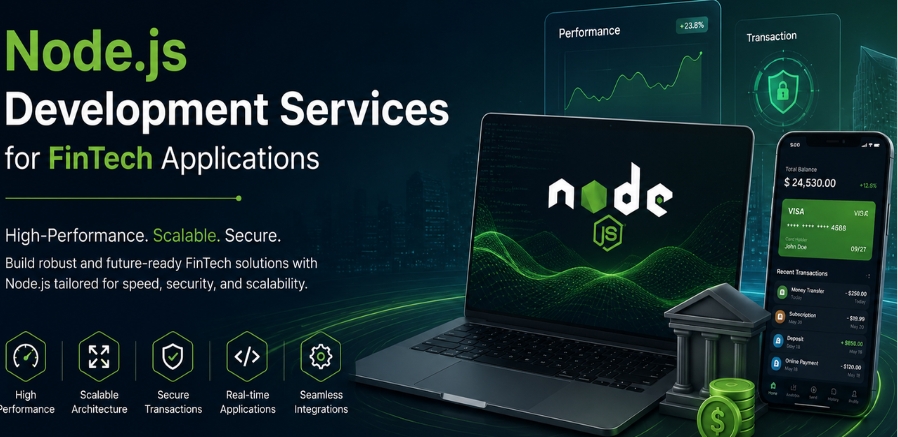
Node.js Development Services for FinTech Applications
Node.js development services for FinTech applications are helping financial businesses build fast, scalable, and responsive digital platforms. From digital wallets and payment solutions to investment platforms and financial management software, modern FinTech products require technology that can handle large transaction volumes while delivering reliable user experiences.
Node.js is particularly suitable for FinTech applications that require real-time data processing, API integrations, scalable backend architecture, and continuous feature development. However, technology alone does not guarantee security or regulatory compliance. A successful FinTech application requires appropriate architecture, secure development practices, testing, monitoring, and compliance controls.
For startups, financial institutions, and growing FinTech companies, choosing the right development technology can directly influence scalability, performance, and long-term operational efficiency.
Why Is Node.js Suitable for FinTech Applications?
Node.js uses an event-driven, non-blocking architecture that can efficiently handle multiple concurrent operations. This makes it useful for applications where users frequently request data or interact with backend services.
Node.js can support FinTech applications that require:
- Real-time transaction updates
- High-performance APIs
- Payment gateway integrations
- Banking API integrations
- Real-time notifications
- Financial dashboards
- Scalable cloud infrastructure
- Microservices architecture
The technology can also work with databases, third-party financial services, authentication systems, and cloud platforms to create integrated financial ecosystems.
Key FinTech Applications Built with Node.js
Node.js can support several types of financial technology products.
Digital Banking Applications
Node.js can be used as part of the backend architecture for digital banking platforms, supporting account management, transaction processing, notifications, and API integrations.
Digital Wallets
Wallet applications require reliable transaction workflows and secure communication between users, payment providers, and backend services.
Payment Platforms
Payment applications need APIs capable of processing requests efficiently while maintaining strong security controls. Node.js can provide the backend layer for payment processing and third-party payment integrations.
Investment Platforms
Investment and portfolio management applications often require real-time market information, account data, notifications, and analytics.
Financial Management Software
Businesses can use Node.js to develop expense management, invoicing, accounting integrations, and financial reporting applications.
Real-Time Processing for Financial Applications
Real-time information is important in many FinTech products. Users may expect immediate updates when a payment is completed, an account balance changes, or a transaction is initiated.
Node.js is well suited to real-time communication using technologies such as WebSockets and event-driven services.
Potential use cases include:
- Transaction notifications
- Account activity updates
- Live financial dashboards
- Payment status updates
- Fraud alerts
- Market information
- Customer notifications
This can improve transparency and create a more responsive financial application.
Node.js and FinTech API Development
APIs are the foundation of many modern financial platforms. A FinTech application may need to communicate with banks, payment processors, identity verification providers, accounting systems, analytics platforms, and other financial services.
Node.js is commonly used for developing:
- REST APIs
- GraphQL APIs
- Banking APIs
- Payment APIs
- Authentication APIs
- Third-party integrations
- Internal microservice APIs
A well-designed API architecture can make it easier to integrate new financial services as the business grows.
Security Is Critical in FinTech Development
Financial applications handle highly sensitive information, so security should be considered from the beginning of the development lifecycle.
A professional Node.js development approach should consider:
- Strong authentication
- Multi-factor authentication
- Role-based access control
- Secure API design
- Encryption
- Input validation
- Rate limiting
- Secure session management
- Dependency monitoring
- Security testing
- Audit logging
Security requirements should be defined according to the application, geographic market, financial services involved, and applicable regulations.
Node.js itself does not automatically make an application secure. Secure architecture, coding practices, infrastructure configuration, testing, and continuous monitoring are essential.
Scalability for Growing FinTech Businesses
FinTech platforms can experience significant increases in users and transaction volumes. A scalable backend architecture helps businesses respond to growth without constantly rebuilding the application.
Node.js supports architectures involving:
- Load balancing
- Horizontal scaling
- Microservices
- Containerization
- Cloud infrastructure
- Distributed services
- Caching systems
This allows businesses to increase computing resources as application demand grows.
Node.js for FinTech Microservices
Microservices can divide a large financial platform into smaller, independently managed services.
For example, a FinTech application could have separate services for:
- User authentication
- Payments
- Transactions
- Notifications
- Reporting
- Customer accounts
- Fraud detection
Node.js works well in microservices environments because lightweight services can communicate through APIs and messaging systems.
However, microservices should not be introduced simply because they are popular. Architecture should be selected according to the application's complexity, team capabilities, scalability requirements, and operational maturity.
Cloud-Based FinTech Development
Modern financial platforms increasingly use cloud infrastructure for flexibility and scalability.
Node.js applications can be deployed using major cloud environments and modern DevOps technologies.
A cloud-based architecture can support:
- Automated deployments
- Application monitoring
- Scalable infrastructure
- Disaster recovery
- Containerized services
- Continuous integration and delivery
Proper cloud architecture is especially important for FinTech applications where availability, security, and data protection are critical.
Benefits of Choosing Node.js for FinTech
Businesses can benefit from Node.js when the project requirements align with its strengths.
Faster Development
JavaScript can be used across different application layers, potentially improving development efficiency.
High Concurrency
The event-driven architecture can efficiently manage many I/O operations.
API-Friendly Architecture
Node.js is well suited for building APIs and integrating third-party financial services.
Scalability
Applications can be architected to scale horizontally as demand increases.
Real-Time Capabilities
Node.js supports applications that require frequent communication between clients and servers.
Large Ecosystem
The Node.js ecosystem provides numerous libraries and tools for application development and integration.
When Should a FinTech Business Choose Node.js?
Node.js can be a strong choice when your financial application requires:
- Real-time communication
- High-concurrency APIs
- Payment integrations
- Cloud-native architecture
- Microservices
- Rapid product development
- Scalable backend infrastructure
- AI or third-party API integrations
For applications with highly specialized computational workloads, businesses may combine Node.js with other technologies rather than relying on a single technology for every component.
How to Choose a Node.js Development Company for FinTech
Choosing the right Node.js development company is particularly important for financial applications.
Evaluate a potential technology partner based on:
- Node.js development experience
- FinTech project experience
- API integration expertise
- Security practices
- Cloud and DevOps capabilities
- Testing methodology
- Scalability expertise
- Post-launch support
Ask for relevant case studies and understand how the company approaches security, testing, monitoring, deployment, and maintenance.
Frequently Asked Questions
Is Node.js good for FinTech application development?
Yes. Node.js can be an effective choice for FinTech applications that require scalable APIs, real-time communication, third-party integrations, and cloud-based infrastructure.
Can Node.js handle financial transactions?
Node.js can be used to build transaction-related backend services. However, transaction reliability depends on the overall architecture, database design, security controls, error handling, and infrastructure.
Is Node.js secure for financial applications?
Node.js can be used to build secure financial applications, but security depends on implementation. Authentication, encryption, secure APIs, dependency management, testing, monitoring, and appropriate compliance controls are essential.
Can Node.js integrate with payment gateways?
Yes. Node.js can integrate with payment gateways and other financial services through APIs and SDKs.
Is Node.js suitable for large FinTech applications?
Yes. With appropriate architecture, Node.js can support large-scale applications using cloud infrastructure, load balancing, caching, microservices, and distributed systems.
Why Choose Askzenix Technologies for Node.js FinTech Development?
At Askzenix Technologies, we provide custom Node.js development services for businesses looking to build scalable and high-performance digital products. Our expertise includes backend development, API development, cloud applications, SaaS platforms, AI integrations, and enterprise software.
For FinTech projects, we focus on business requirements, scalable architecture, secure development practices, API integrations, testing, and long-term maintainability.
Whether you're developing a digital wallet, payment platform, financial dashboard, investment application, or custom FinTech solution, the technology architecture should be designed around your specific business and regulatory requirements.
Conclusion
Node.js development services for FinTech applications provide businesses with a flexible foundation for developing scalable APIs, real-time services, payment integrations, and cloud-based financial platforms.
Node.js can be particularly valuable for FinTech products that need high concurrency, rapid development, real-time communication, and scalable backend architecture. However, financial software requires more than technology selection. Security, compliance, testing, data protection, monitoring, and reliable architecture must be considered throughout the development lifecycle.
By working with an experienced Node.js development company, FinTech businesses can build secure, scalable, and maintainable applications designed to support current requirements while preparing for future growth.