 Chat with us
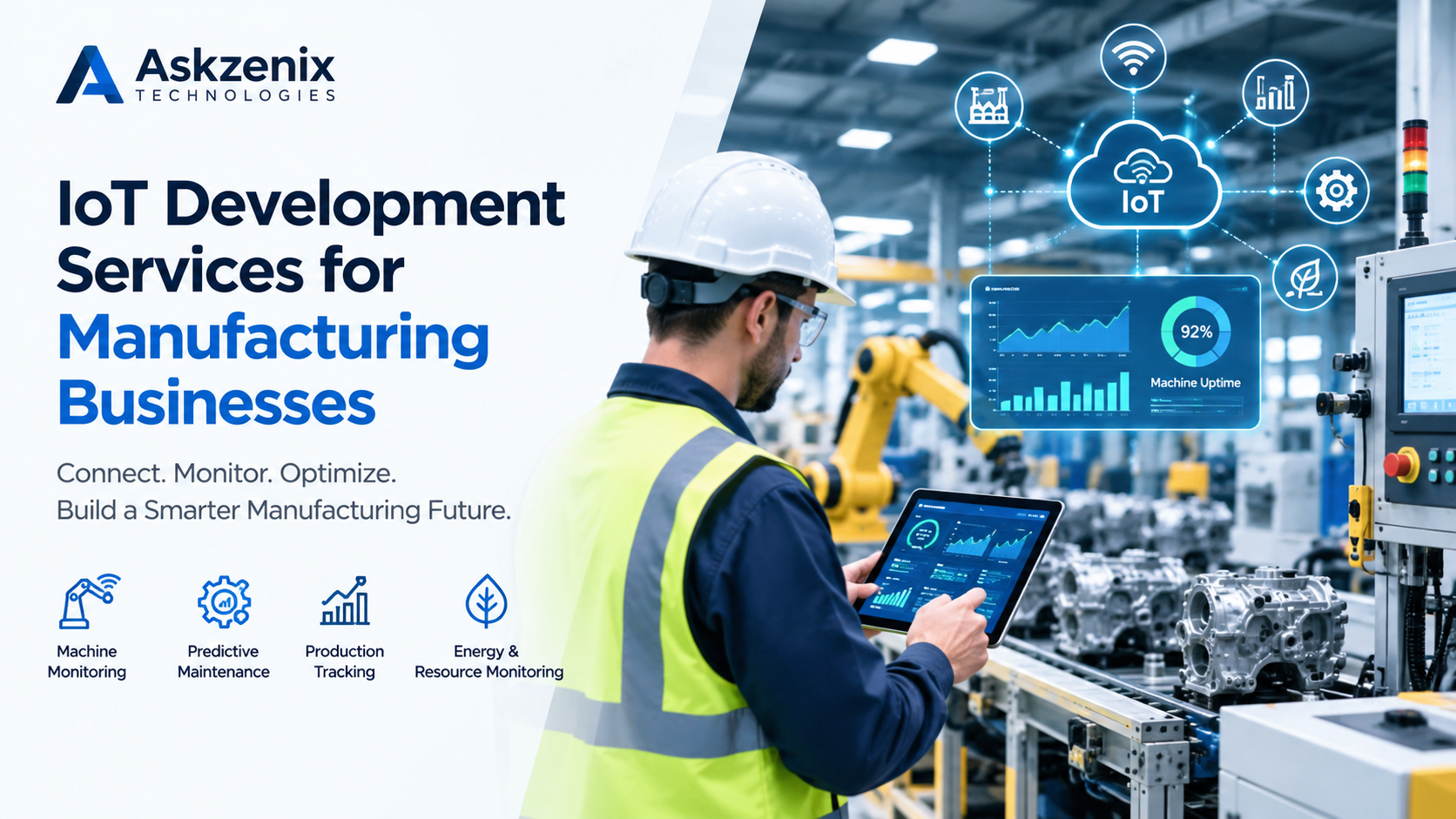
IoT Development Services for Manufacturing Businesses
Manufacturing businesses are increasingly using connected technologies to improve production visibility, reduce equipment downtime, optimize resources, and make faster operational decisions. IoT development services for manufacturing help companies connect machines, sensors, software systems, and business applications to create a connected manufacturing environment.
Industrial IoT solutions can collect real-time information from production equipment, monitor machine performance, identify unusual patterns, and provide actionable information through web and mobile dashboards. When designed around specific manufacturing requirements, IoT can become an important part of digital transformation.
What Is IoT in Manufacturing?
IoT in manufacturing refers to connecting machines, equipment, sensors, and industrial systems to software platforms that collect and analyze operational data.
For example, sensors installed on production equipment can capture information such as temperature, vibration, pressure, energy consumption, machine status, and production cycles. This information can then be transmitted to an IoT platform where it can be monitored, analyzed, and used to trigger alerts or automated actions.
This approach is commonly associated with Industrial Internet of Things (IIoT) and smart manufacturing.
How IoT Development Services Help Manufacturers
Manufacturers generate large amounts of operational data, but collecting data alone does not necessarily improve productivity. The value comes from turning that data into useful information for operators, engineers, and management.
A manufacturing IoT development company can design solutions for real-time machine monitoring, production tracking, asset management, predictive maintenance, energy monitoring, quality control, and operational analytics.
IoT dashboards can provide teams with a centralized view of machine performance and production activity. Automated alerts can also notify responsible teams when predefined thresholds or unusual conditions are detected.
Predictive Maintenance With IoT
Equipment downtime can affect production schedules, operating costs, and delivery commitments. IoT can help manufacturers monitor machine conditions continuously rather than relying only on periodic inspections.
Sensors can collect information related to vibration, temperature, pressure, power consumption, and other machine parameters. Analytics can then identify patterns that may indicate abnormal equipment behavior.
With the right data and analytical models, manufacturers can develop predictive maintenance capabilities that help maintenance teams investigate potential problems before they result in significant equipment failure.
Real-Time Production Monitoring
Traditional production reporting may depend on manual data collection or periodic updates. IoT enables more frequent and automated collection of production information.
Connected machines can transmit operational data to centralized platforms, allowing supervisors and managers to monitor production activity through dashboards.
Depending on the implementation, businesses can track machine status, production cycles, downtime events, operating parameters, and other key metrics.
This can improve visibility across production operations and help teams identify issues that require attention.
Energy and Resource Monitoring
Energy consumption is another area where IoT can provide useful operational insights.
Connected meters and sensors can monitor electricity, gas, water, compressed air, or other resources across equipment and production areas. The collected data can be analyzed to identify unusual consumption patterns and areas where resources may be optimized.
For manufacturers with energy-intensive operations, continuous monitoring can provide more detailed information than periodic manual readings.
IoT Integration With Existing Manufacturing Systems
A manufacturing IoT solution rarely operates independently. Businesses may already use ERP, MES, CRM, SCADA, warehouse management, or other enterprise systems.
An experienced IoT development company should therefore consider API integration and data exchange during the architecture stage.
Connecting IoT platforms with existing business applications can help combine machine-level information with production, inventory, maintenance, or business data.
For example, machine data can potentially be connected with production planning information to provide a broader view of operational performance.
IoT Security for Manufacturing
Security is a critical consideration when connecting industrial equipment and business systems.
Manufacturing IoT solutions should incorporate appropriate device authentication, encrypted communication, access controls, API security, monitoring, and secure device management.
Security requirements should be considered from the architecture and development stages rather than added after deployment.
Manufacturers should also evaluate how software updates, device credentials, user permissions, and system logs will be managed throughout the lifecycle of the solution.
Scalable IoT Architecture for Smart Manufacturing
Manufacturing businesses may begin with a pilot involving a small number of machines and later expand the solution across multiple production lines or facilities.
A scalable architecture should therefore be planned from the beginning. The platform should be capable of handling additional devices, increasing data volumes, new locations, additional users, and future integrations.
Cloud platforms, edge computing, APIs, databases, and appropriate communication protocols can be combined according to the operational requirements of the manufacturing environment.
How to Choose an IoT Development Partner
When selecting an IoT development company, manufacturers should look beyond a generic technology portfolio.
Evaluate the company's experience with industrial systems, device integration, cloud technologies, APIs, data processing, cybersecurity, application development, and software testing.
Ask potential partners about previous IoT implementations, scalability, system architecture, testing methodology, security practices, deployment process, and post-launch support.
A development partner should also be able to explain complex technical decisions in business terms and provide a practical roadmap for moving from proof of concept to production.
IoT Development Services by Askzenix Technologies
Askzenix Technologies provides software development and digital transformation services that can support manufacturing businesses implementing connected technology solutions.
Its capabilities across IoT-related software development, web and mobile applications, backend development, API integration, cloud technologies, AI, data processing, and software testing can help businesses develop solutions around specific manufacturing requirements.
Whether the objective is machine monitoring, production visibility, predictive maintenance, resource monitoring, or integration with existing enterprise applications, the development approach should begin with understanding the business process and defining the appropriate technical architecture.
Frequently Asked Questions About IoT in Manufacturing
What are IoT development services for manufacturing?
IoT development services for manufacturing involve designing and developing connected solutions that allow machines, sensors, software platforms, and business systems to exchange and analyze operational data.
What are the benefits of IoT in manufacturing?
IoT can help manufacturers improve machine visibility, monitor production, identify equipment issues, analyze resource consumption, automate alerts, and support data-driven operational decisions.
How is IoT used for predictive maintenance?
IoT sensors collect machine-condition data such as vibration, temperature, pressure, and energy consumption. This information can be analyzed to identify unusual patterns and potential equipment problems.
Is IoT suitable for small and medium-sized manufacturers?
Yes. IoT implementation does not necessarily require connecting an entire factory at once. Businesses can begin with a specific machine, production line, or operational problem and expand the solution based on results and requirements.
Conclusion
IoT development services for manufacturing businesses can help transform machine and production data into actionable operational information. From real-time monitoring and predictive maintenance to energy management and enterprise integration, IoT can support manufacturers in building more connected and data-driven operations.
The key is to develop an IoT solution around a clearly defined business objective, with appropriate attention to scalability, security, integration, testing, and long-term support. Working with an experienced IoT development partner can help manufacturers move from an initial concept or pilot toward a reliable production-ready solution