 Chat with us
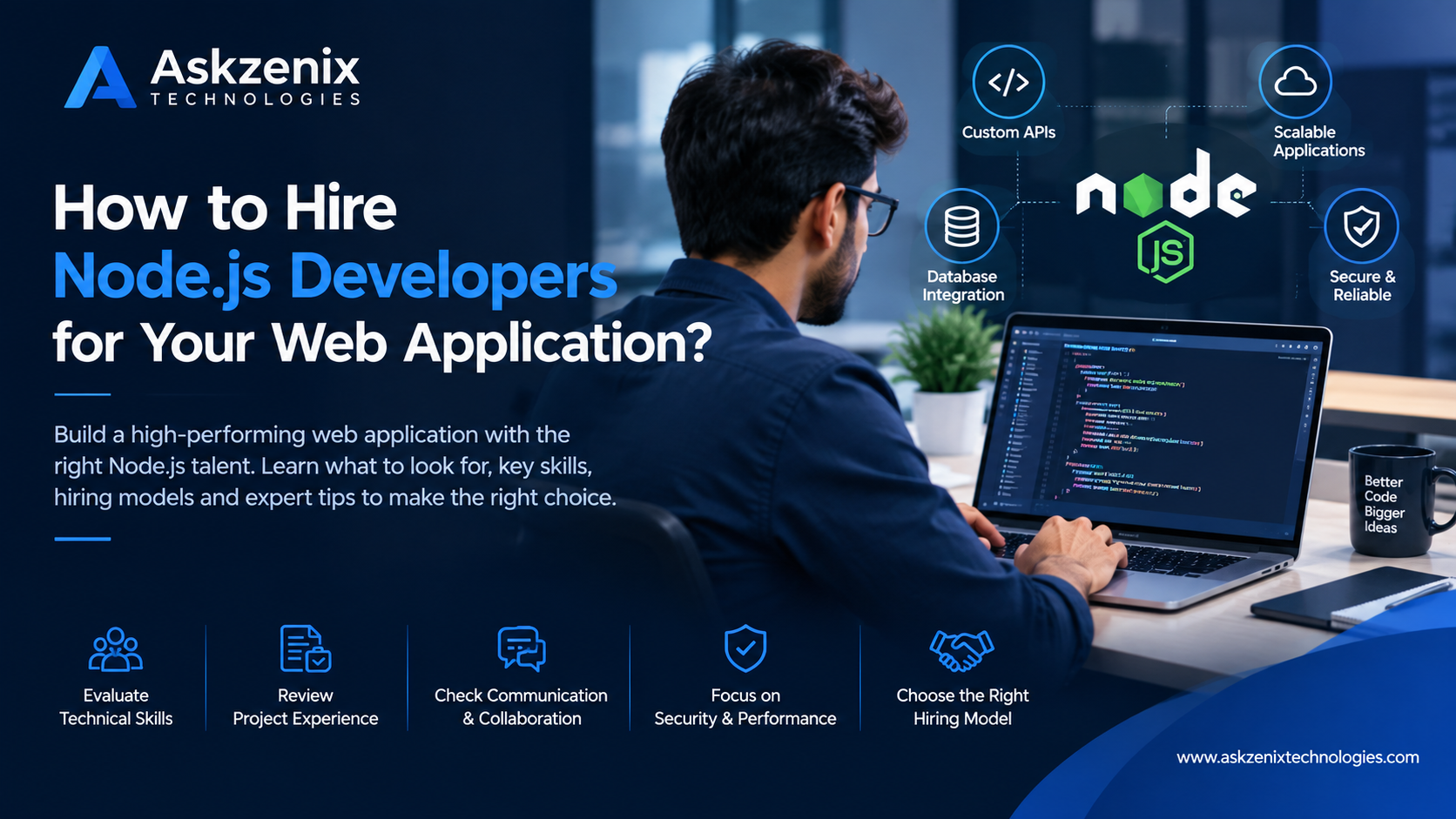
How to Hire Node.js Developers for Your Web Application?
Hiring the right Node.js developers for your web application is important for building a backend that is fast, secure, scalable, and easy to maintain. Node.js is widely used for modern web applications, APIs, SaaS platforms, real-time applications, eCommerce platforms, and enterprise software because it enables developers to build server-side applications using JavaScript.
However, hiring a Node.js developer should involve more than checking whether a candidate knows the technology. Businesses need developers who understand backend architecture, databases, APIs, security, performance optimization, cloud deployment, and the specific requirements of the application.
If you are planning to build a new web application or improve an existing platform, this guide explains what to look for when hiring Node.js developers and how to choose the right development model.
Why Hire Node.js Developers for a Web Application?
Node.js is based on a non-blocking, event-driven architecture that can efficiently handle multiple concurrent requests. This makes it suitable for applications where responsiveness and scalability are important.
Experienced Node.js developers can build REST APIs, GraphQL APIs, real-time communication systems, microservices, backend applications, integrations, and cloud-based solutions.
Node.js can also work with databases such as MongoDB, PostgreSQL, MySQL, and Redis and can be integrated with frontend technologies such as React, Angular, and Vue.
For businesses, this can simplify development when JavaScript is used across both frontend and backend layers.
Define Your Web Application Requirements
Before you hire Node.js developers, clearly define what you want to build. Your requirements will determine the experience and technical skills you need.
Consider the application's purpose, target users, expected traffic, required features, integrations, database requirements, authentication, payment processing, hosting environment, and future scalability.
For example, a simple business application may require a Node.js developer with strong API and database experience, while a large SaaS platform may require developers experienced in microservices, cloud infrastructure, caching, queues, security, and performance optimization.
Clear requirements also make it easier to estimate development time and identify the appropriate developer experience level.
Check the Developer's Node.js Skills
A professional Node.js developer should understand more than basic JavaScript.
Look for experience with modern JavaScript, asynchronous programming, Node.js architecture, API development, error handling, authentication, database integration, testing, and application security.
Depending on the project, useful technologies may include Express.js, NestJS, MongoDB, PostgreSQL, Redis, REST, GraphQL, Docker, Git, AWS, Azure, or other cloud technologies.
The exact stack should be selected according to the project rather than simply choosing technologies because they are popular.
Evaluate Real Project Experience
A developer's previous project experience can provide valuable insight into their ability to handle real development challenges.
Ask candidates or development companies about applications they have worked on and their responsibilities within those projects. Instead of only reviewing screenshots, understand what they actually developed.
Questions can include:
What type of Node.js applications have you built?
Have you developed APIs for production applications?
How have you handled database performance?
Have you worked with third-party APIs?
How have you secured authentication and user data?
Have you deployed Node.js applications to cloud environments?
How have you handled high traffic or increasing users?
Practical experience is particularly important when hiring developers for a business-critical application.
Assess API and Database Knowledge
Most modern web applications depend heavily on APIs and databases. Therefore, API and database knowledge should be an important part of your hiring evaluation.
A capable Node.js developer should understand API architecture, authentication, authorization, validation, error handling, database queries, indexing, transactions, caching, and data security.
The developer should also be able to select an appropriate database based on the application's data model and performance requirements.
For example, MongoDB may be suitable for certain document-oriented applications, while PostgreSQL or MySQL may be more appropriate for applications requiring strong relational data management.
Don't Ignore Security
Security should be considered from the beginning of backend development.
When hiring Node.js developers, evaluate their understanding of authentication, authorization, input validation, secure API design, encryption, password protection, dependency management, and common web application vulnerabilities.
Developers should also understand how sensitive information should be handled and how access permissions should be implemented.
Security problems discovered after deployment can be considerably more expensive to resolve than security considerations incorporated during development.
Test Problem-Solving Ability
Technical knowledge alone does not always indicate whether a developer will be effective on your project.
During the hiring process, consider using a practical technical assessment based on your application requirements. For example, you could ask the developer to design an API, identify a performance issue, structure a database, or explain how they would handle increasing traffic.
The goal should be to understand how the developer approaches technical problems rather than simply testing memorized syntax.
Choose the Right Hiring Model
Businesses generally have several options when hiring Node.js developers. You can hire an in-house developer, work with freelancers, or use a software development company or dedicated development team.
An in-house developer can be useful when you need long-term internal ownership. Freelancers can work well for smaller or clearly defined assignments. A development company or dedicated team can provide access to multiple skills such as backend development, frontend development, UI/UX, DevOps, and quality assurance.
The right model depends on your project scope, budget, timeline, management requirements, and long-term plans.
Consider Communication and Collaboration
A technically strong Node.js developer still needs to communicate effectively with your team.
Before hiring, understand how the developer or development company manages requirements, documentation, progress updates, code reviews, testing, issue tracking, and deployment.
Experience with tools such as Git, Jira, Slack, Microsoft Teams, or similar collaboration platforms can also be useful for distributed development teams.
Good communication can reduce misunderstandings and help keep development aligned with business objectives.
Understand the Cost of Hiring Node.js Developers
The cost of hiring Node.js developers varies depending on experience, location, project complexity, engagement model, and required technical skills.
Instead of comparing hourly rates alone, consider the overall value of the development engagement. A lower rate may not necessarily result in a lower total project cost if the developer requires extensive supervision or produces difficult-to-maintain code.
When evaluating proposals, ask what is included in the engagement, including development, testing, deployment, documentation, project management, maintenance, and technical support.
Why Hire Node.js Developers From Askzenix Technologies?
Askzenix Technologies provides Node.js development services for businesses that need custom web applications, APIs, backend systems, integrations, and scalable software solutions.
A Node.js development team can work alongside frontend developers, QA engineers, DevOps professionals, and project managers when a project requires broader technical capabilities.
For businesses that do not want to build a complete internal development team, dedicated Node.js developers can provide an alternative approach for expanding development capacity while maintaining control over project requirements and priorities.
Frequently Asked Questions
How do I hire a good Node.js developer?
Start by defining your application requirements and then evaluate candidates based on Node.js experience, JavaScript knowledge, API development, database expertise, security awareness, testing experience, cloud deployment, problem-solving ability, and communication skills.
What skills should a Node.js developer have?
A Node.js developer should typically understand JavaScript, asynchronous programming, API development, databases, authentication, security, testing, Git, and application deployment. Additional skills such as Docker, cloud platforms, Redis, microservices, and GraphQL may be required depending on the project.
How much does it cost to hire a Node.js developer?
The cost depends on the developer's experience, location, engagement model, project complexity, and required technology stack. Businesses should compare the complete scope of work rather than focusing only on hourly rates.
Should I hire a freelance Node.js developer or a development company?
The choice depends on the project. Freelancers may be suitable for specific development tasks, while a development company can provide a broader team covering development, testing, DevOps, project management, and ongoing support.
Conclusion
Hiring the right Node.js developers for your web application requires a clear understanding of your project requirements and a structured evaluation of technical and professional capabilities.
Look beyond basic Node.js knowledge and assess experience with APIs, databases, security, performance, testing, cloud deployment, and scalable architecture. You should also consider communication, development processes, pricing transparency, and long-term support.
Whether you need one dedicated Node.js developer or a complete development team, choosing a partner with relevant experience can help you build a reliable backend and create a stronger foundation for your web application's future growth.