 Chat with us
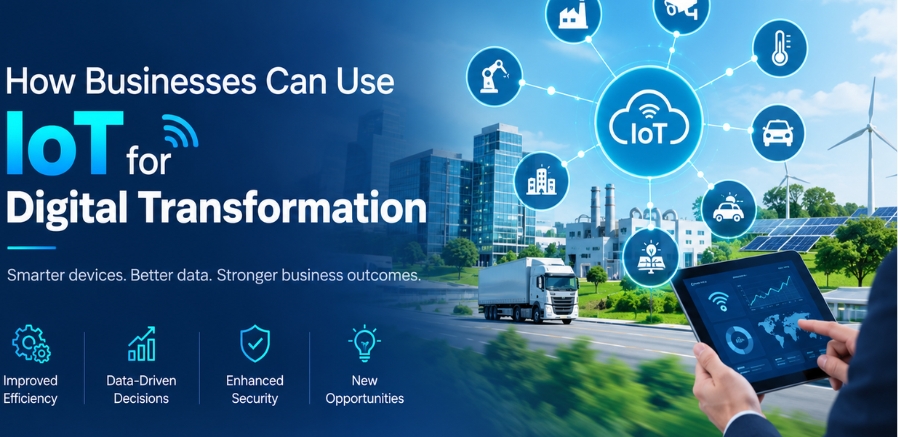
How Businesses Can Use IoT for Digital Transformation
Digital transformation is no longer limited to moving business processes to the cloud or replacing manual systems with software. Businesses are increasingly connecting physical devices, machines, sensors, applications, and data to create intelligent digital ecosystems. IoT services make this possible by helping organizations collect real-time information from connected devices, analyze that data, automate processes, and make faster business decisions.
From manufacturing and logistics to healthcare, retail, real estate, agriculture, and energy, Internet of Things technology is changing how organizations operate. With the right IoT strategy, businesses can improve operational visibility, reduce unnecessary costs, enhance customer experiences, and create new digital services.
What Are IoT Services?
IoT services include the technologies, development capabilities, integration services, and consulting required to connect physical devices with software platforms and business systems.
An IoT ecosystem typically includes sensors or connected devices, communication networks, cloud or edge infrastructure, IoT platforms, data processing systems, analytics, dashboards, and applications. These components work together to collect and use data generated by physical assets.
For example, a manufacturing company can install sensors on production equipment to monitor temperature, vibration, energy consumption, and machine performance. The collected data can be analyzed to identify unusual patterns and potentially predict equipment failures before they cause major downtime.
IoT services can cover the complete lifecycle of such a solution, including IoT consulting, device integration, application development, cloud integration, data analytics, monitoring, security, and ongoing maintenance.
How IoT Supports Digital Transformation
IoT becomes particularly valuable when businesses move from reactive decision-making toward real-time, data-driven operations.
Traditional business systems often depend on employees manually entering information or periodically checking equipment and processes. IoT can continuously collect data from physical environments and make that information available to business applications.
This creates a connection between the physical and digital sides of an organization.
For example, instead of discovering that a machine has stopped working after production is interrupted, connected sensors can provide information about machine conditions before a failure occurs. Instead of manually checking inventory, connected systems can provide near-real-time information about stock levels and asset movement.
This combination of connectivity, data, analytics, and automation can become an important foundation for digital transformation.
Key Ways Businesses Can Use IoT
Predictive Maintenance
Predictive maintenance is one of the most practical applications of IoT, particularly for manufacturing, transportation, utilities, and other asset-intensive industries.
Sensors can monitor equipment conditions such as vibration, temperature, pressure, energy consumption, and operating cycles. Analytics systems can then identify abnormal patterns and help maintenance teams determine when equipment may require inspection or servicing.
This can help businesses move from reactive maintenance toward condition-based maintenance and potentially reduce unexpected downtime.
Real-Time Asset Monitoring
Businesses with large numbers of physical assets can use IoT to improve visibility across their operations.
Connected tracking devices can provide information about the location, status, utilization, or operating condition of equipment and other assets. This can be useful for logistics companies, construction businesses, manufacturers, field-service organizations, and enterprises managing distributed assets.
Real-time monitoring can also help organizations identify underutilized assets and improve resource allocation.
Smart Manufacturing
IoT plays a significant role in modern manufacturing environments.
Industrial IoT solutions can connect machines, production lines, sensors, enterprise applications, and analytics platforms. Businesses can use this information to monitor production performance, identify bottlenecks, track quality indicators, and optimize resource consumption.
When IoT data is combined with artificial intelligence and machine learning, manufacturers can build more advanced systems for anomaly detection, forecasting, quality analysis, and predictive maintenance.
Energy Management
IoT can help businesses understand how energy is being consumed across buildings, facilities, machines, and equipment.
Smart meters and connected sensors can collect information about electricity consumption, temperature, equipment operation, and environmental conditions. Businesses can analyze this information to identify inefficient processes and optimize energy usage.
For organizations operating multiple facilities, centralized dashboards can provide a broader view of energy performance.
Supply Chain and Logistics
IoT can improve supply chain visibility by connecting vehicles, containers, warehouses, products, and other assets.
Organizations can use connected devices to monitor location, environmental conditions, movement, and delivery status. For temperature-sensitive goods, sensors can also help monitor conditions throughout transportation and storage.
This creates better visibility across the supply chain and can help businesses respond more quickly when operational issues occur.
Smart Buildings and Facilities
IoT solutions can transform conventional buildings into connected environments.
Sensors can monitor occupancy, temperature, lighting, air quality, energy consumption, and equipment status. Facility teams can use these insights to improve building operations and potentially reduce unnecessary energy consumption.
Smart building applications can also improve occupant experiences by automating lighting, climate control, access systems, and maintenance workflows.
Customer Experience
IoT is not only about operational efficiency. Connected products can also create new customer experiences.
Businesses can use connected devices to understand product usage, provide remote monitoring, deliver automated alerts, and offer personalized services.
For example, a connected equipment manufacturer can provide customers with a dashboard showing equipment health, usage information, maintenance requirements, and service notifications.
This can turn a one-time product transaction into an ongoing digital service relationship.
What Does an IoT Solution Architecture Look Like?
A typical IoT solution connects multiple technology layers.
The first layer consists of devices and sensors that collect information from the physical environment. The communication layer transfers this information using appropriate connectivity technologies.
The data can then be processed through edge computing or cloud infrastructure, depending on the requirements of the application. An IoT platform can manage devices, data flows, rules, and integrations.
The application layer provides dashboards, mobile applications, alerts, reports, and business workflows. Finally, analytics and AI technologies can transform collected data into actionable insights.
The architecture should be designed according to factors such as device volume, latency requirements, connectivity, security, scalability, data retention, and business objectives.
IoT and Artificial Intelligence: A Powerful Combination
IoT generates large amounts of operational data, while AI can help businesses interpret that data.
For example, an IoT system can collect thousands of sensor readings from industrial equipment. Machine learning models can analyze historical and real-time data to identify patterns associated with equipment failures.
Similarly, connected retail systems can provide information about customer behavior and inventory, while AI can help identify demand patterns and support forecasting.
This combination is often referred to as AIoT, or Artificial Intelligence of Things. It brings together connected devices, data, analytics, and intelligent automation.
Benefits of IoT Services for Businesses
Implementing IoT can provide several business benefits when the solution is aligned with measurable objectives.
Better operational visibility: Businesses can access real-time information about equipment, processes, and assets.
Process automation: Connected systems can automatically trigger alerts, workflows, or actions based on predefined conditions.
Improved efficiency: Data can reveal operational bottlenecks, unnecessary resource usage, and inefficient processes.
Reduced downtime: Predictive and condition-based monitoring can help identify potential problems earlier.
Data-driven decisions: Management teams can use real-time operational data instead of relying solely on manual reports.
Better customer service: Connected products can support remote monitoring, proactive service, and personalized experiences.
New revenue opportunities: Companies can create subscription-based monitoring, analytics, maintenance, and connected-product services.
IoT Security Should Be Part of the Strategy
Security is a critical consideration when implementing IoT.
Connected devices increase the number of endpoints that an organization must manage and protect. An effective IoT strategy should therefore consider device authentication, secure communication, access control, data protection, firmware management, network security, monitoring, and vulnerability management.
Security should not be treated as an afterthought. It should be incorporated into the architecture from the beginning.
Businesses should also establish clear policies for device lifecycle management, software updates, credentials, data access, and system monitoring.
How to Start an IoT Digital Transformation Project
A successful IoT initiative starts with a business problem rather than simply deploying connected devices.
Organizations should first identify where real-time data or automation could create measurable value. This could be reducing machine downtime, improving asset utilization, optimizing energy consumption, improving supply chain visibility, or enhancing customer service.
The next step is to define the required devices, connectivity, data architecture, applications, integrations, security controls, and analytics capabilities.
Starting with a focused pilot can help businesses validate the technology and business case before expanding the solution across additional locations, assets, or processes.
Scalability should also be considered from the beginning. An IoT solution that works for 100 devices may require a different architecture when the organization needs to manage thousands or millions of connected endpoints.
Why Businesses Need Professional IoT Development Services
IoT projects often involve multiple technologies and systems. Device connectivity, APIs, cloud platforms, databases, mobile applications, analytics, cybersecurity, and enterprise integrations may all need to work together.
Professional IoT development services can help businesses design an architecture around their specific operational requirements instead of adopting a generic solution.
An experienced IoT development partner can assist with solution consulting, IoT application development, device integration, cloud connectivity, dashboards, mobile applications, API development, data analytics, system integration, security, testing, deployment, and maintenance.
The right approach depends on the business environment, existing technology stack, connected devices, data requirements, and long-term digital transformation objectives.
Why Choose Askzenix Technologies for IoT Services?
Askzenix Technologies helps businesses explore technology solutions that connect applications, data, automation, and modern digital platforms. Its technology capabilities can support organizations looking to develop connected applications and integrate IoT capabilities into broader digital transformation initiatives.
For businesses evaluating an IoT project, the focus should be on creating a solution that addresses a specific operational challenge and delivers measurable business value. Whether the requirement involves connected devices, real-time dashboards, mobile applications, cloud integration, automation, or intelligent analytics, an experienced technology partner can help turn the concept into a scalable digital solution.
Frequently Asked Questions About IoT Services
What are IoT services?
IoT services include consulting, development, device integration, cloud connectivity, data processing, application development, analytics, security, deployment, and maintenance required to build and operate Internet of Things solutions.
How can IoT help with digital transformation?
IoT connects physical assets and processes with digital systems. It enables organizations to collect real-time data, automate workflows, monitor operations, improve efficiency, and make more informed decisions.
Which industries can benefit from IoT?
Manufacturing, logistics, healthcare, retail, agriculture, energy, real estate, automotive, construction, and facilities management are among the industries that can benefit from IoT solutions.
Is IoT useful for small and medium-sized businesses?
Yes. SMEs do not necessarily need a large IoT deployment. A focused solution addressing a specific business problem, such as equipment monitoring, asset tracking, energy management, or inventory visibility, can be a practical starting point.
How much does IoT development cost?
The cost depends on factors such as the number and type of devices, connectivity requirements, software complexity, cloud infrastructure, integrations, security requirements, analytics, and maintenance. A pilot project generally provides a better basis for estimating the cost of a larger deployment.
What is the difference between IoT and AIoT?
IoT focuses on connecting devices and collecting and exchanging data. AIoT combines IoT with artificial intelligence and machine learning to analyze connected-device data and support prediction, automation, and intelligent decision-making.
How can a business start an IoT project?
Start by identifying a measurable business problem where connected data can create value. Define the required devices, data, integrations, security requirements, and expected outcomes, then validate the idea through a focused pilot before scaling.
Conclusion
IoT is becoming an important component of digital transformation because it connects the physical world with business software and data. From predictive maintenance and smart manufacturing to asset monitoring, energy management, logistics, and connected customer experiences, businesses can use IoT to create more responsive and data-driven operations.
However, successful IoT adoption is not simply about connecting more devices. The strongest solutions begin with a clear business objective, secure architecture, reliable data, scalable infrastructure, and a plan for turning information into action.
Businesses looking to modernize their operations can use IoT services as a foundation for building connected, automated, and intelligent digital ecosystems