 Chat with us
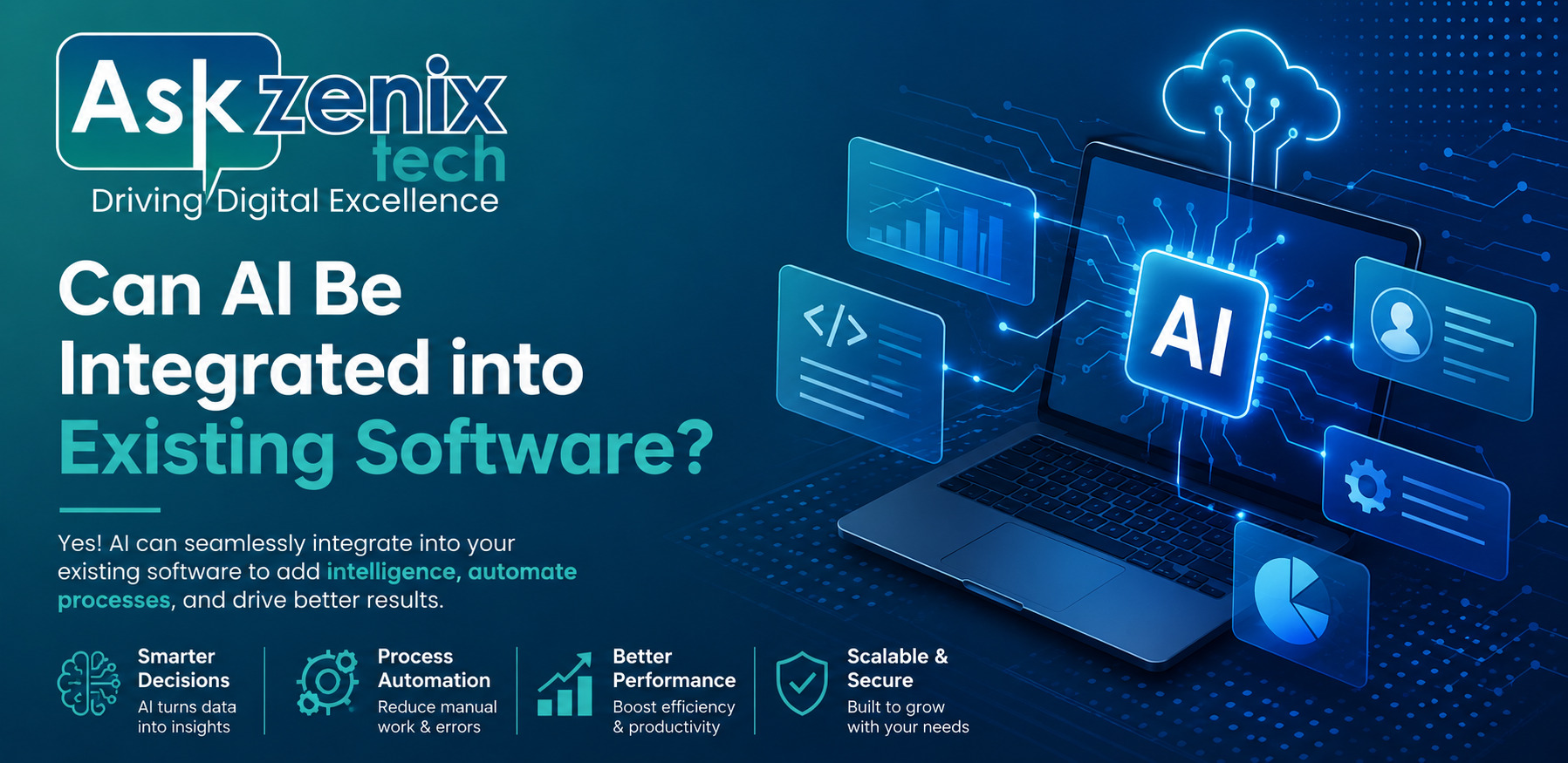
Can AI Be Integrated into Existing Software? A Strategic Guide for Modern Businesses
For many organizations, the biggest barrier to AI adoption isn't the technology—it's the assumption that implementing AI requires replacing existing software. In reality, that's rarely the case.
AI can be integrated into existing software without rebuilding the entire application. Whether your business relies on a custom ERP, CRM, eCommerce platform, healthcare application, or SaaS product, AI can enhance existing capabilities through APIs, machine learning models, and intelligent automation.
Today's AI strategy isn't about replacing software—it's about making it smarter.
Instead of investing in costly software redevelopment, businesses are embedding AI into their current systems to automate workflows, improve decision-making, personalize user experiences, and unlock greater value from existing data.
Why AI Integration Makes More Sense Than Software Replacement
Most enterprise applications already support core business operations effectively. The challenge lies in meeting modern expectations such as real-time insights, intelligent automation, and personalized customer experiences.
Replacing an entire application introduces significant costs, migration risks, and operational disruption. AI integration offers a more practical alternative by extending existing software with intelligent capabilities while preserving business continuity.
Organizations are increasingly integrating AI to:
Automate repetitive business processes
- Enhance customer engagement
- Improve operational efficiency
- Accelerate decision-making
- Increase employee productivity
- Generate predictive business insights
This approach enables businesses to modernize their technology stack while protecting previous software investments.
Where Can AI Be Integrated?
AI is no longer limited to standalone applications. It can be embedded across almost every business system.
Common integration scenarios include:
- Customer Relationship Management (CRM)
- Enterprise Resource Planning (ERP)
- Healthcare Management Systems
- HR and Recruitment Platforms
- eCommerce Applications
- Manufacturing Software
- Logistics and Supply Chain Systems
- Banking and Financial Applications
- Learning Management Systems (LMS)
- Custom Web and Mobile Applications
If an application exposes APIs, stores structured business data, or supports third-party integrations, AI integration is typically achievable without major architectural changes.
High-Impact AI Use Cases for Existing Software
Successful AI integration begins with solving a business problem rather than adding AI for its own sake.
Intelligent Customer Support
AI-powered virtual assistants can resolve routine customer queries, automate ticket classification, and provide 24/7 support. This reduces response times while allowing support teams to focus on complex customer issues.
Predictive Business Analytics
Instead of relying solely on historical reports, AI analyzes operational data to forecast sales, customer demand, inventory requirements, and business performance. Predictive insights help organizations make proactive rather than reactive decisions.
Workflow Automation
Many organizations still depend on manual processes for approvals, document handling, invoice processing, and data entry. AI automates these repetitive workflows, reducing errors and improving operational efficiency.
Personalized User Experiences
AI enables applications to deliver intelligent recommendations based on customer behavior, purchase history, and preferences. This improves engagement, increases conversion rates, and enhances customer retention.
Choosing the Right AI Integration Approach
Not every business requires a custom AI model. The most effective integration strategy depends on business objectives, existing infrastructure, and data maturity.
Businesses generally choose from four approaches:
AI APIs: Ideal for adding chatbots, language processing, document analysis, and image recognition with minimal development effort.
Cloud AI Services: Suitable for organizations seeking scalable AI capabilities without managing complex infrastructure.
Custom Machine Learning Models: Best for businesses requiring industry-specific predictions or proprietary intelligence.
Hybrid AI Architecture: Combines cloud AI services with custom models for enterprise-grade performance, flexibility, and governance.
Selecting the right architecture ensures scalability while controlling implementation costs.
Challenges Businesses Should Address Before AI Integration
Although AI integration is more accessible than ever, successful implementation depends on preparation.
The most common challenges include:
- Poor-quality or fragmented business data
- Legacy systems with limited integration capabilities
- Data privacy and regulatory compliance
- Security and access management
- Unrealistic ROI expectations
- Limited AI governance
Organizations that address these challenges early achieve faster adoption and stronger business outcomes.
Best Practices for Successful AI Integration
The highest-performing AI projects follow a phased implementation strategy.
Start by identifying a process that consumes significant manual effort or directly impacts customer experience. Conduct a technical assessment of the existing software to understand available APIs, data quality, and integration opportunities.
Rather than deploying AI across the organization at once, begin with a pilot project. Measure improvements using clear KPIs such as response time, operational efficiency, customer satisfaction, or revenue growth before expanding to additional business functions.
Most importantly, treat AI as a business capability—not simply another software feature. Successful organizations align AI initiatives with measurable business objectives, ensuring technology investments deliver long-term value.
Conclusion:
The question is no longer whether AI can be integrated into existing software—it's how businesses can integrate it strategically to create measurable value.
Organizations that modernize existing applications instead of replacing them can accelerate digital transformation while minimizing cost and operational risk. Whether through intelligent automation, predictive analytics, conversational AI, or personalized user experiences, AI enables businesses to extend the capabilities of their current software and remain competitive in an increasingly data-driven economy.
As AI continues to evolve, companies that adopt a structured, business-first integration strategy will be better positioned to innovate, improve operational efficiency, and deliver exceptional customer experiences without abandoning the systems they already rely on.