 Chat with us
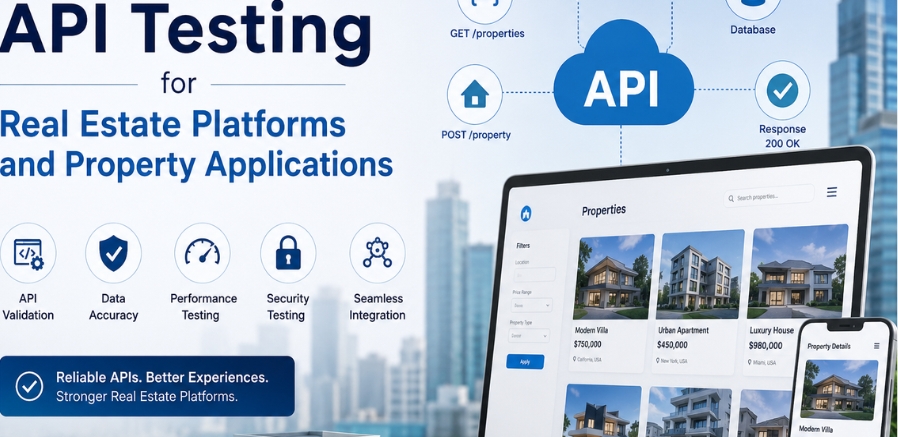
API Testing for Real Estate Platforms and Property Applications
API Testing for Real Estate Platforms is essential for ensuring that property websites and applications deliver accurate data, reliable integrations, secure transactions, and consistent user experiences. Modern real estate platforms depend on APIs to connect property listings, search systems, maps, CRM platforms, payment gateways, lead management tools, and third-party services.
A small API error can result in incorrect property information, missing listings, failed lead submissions, inaccurate search results, or payment failures. Professional API Testing Services help real estate businesses identify these issues before they affect customers and business operations.
Why Is API Testing Important for Real Estate Applications?
Real estate platforms handle large volumes of property and customer data. A typical application may allow users to search properties, apply filters, view images, contact agents, schedule visits, submit inquiries, and make payments.
Behind these features, APIs transfer information between different systems.
API testing helps verify that:
- Property data is accurate and consistent
- Search and filter functions return relevant results
- User authentication works correctly
- Property images and details load properly
- Lead forms submit information successfully
- CRM integrations work as expected
- Payment APIs process transactions correctly
- Third-party services communicate reliably
- APIs remain responsive under high traffic
For platforms with thousands or millions of property records, API reliability can directly influence customer experience and business performance.
Key APIs Used in Real Estate Platforms
Real estate applications commonly use multiple APIs to support different business functions.
Property Listing APIs
Property listing APIs manage information such as property names, locations, prices, property types, specifications, availability, images, and descriptions.
Testing ensures that the correct information is retrieved and displayed without duplication or data loss.
Search and Filter APIs
Search APIs allow users to find properties based on criteria such as:
- Location
- Property type
- Price range
- Number of bedrooms
- Property size
- Amenities
- Availability
QA teams can test different combinations of filters to ensure that the API returns accurate and relevant results.
Map and Location APIs
Real estate platforms often integrate mapping and location services to display properties geographically.
API testing can verify coordinates, addresses, distance calculations, location searches, and map-related responses.
CRM and Lead APIs
Property portals frequently connect with CRM systems to transfer leads to sales teams.
Testing ensures that customer information such as names, phone numbers, email addresses, property preferences, and inquiries are transferred correctly.
Payment APIs
Some real estate platforms process booking fees, property payments, subscriptions, or other online transactions.
Payment API testing can validate transaction workflows, authentication, error handling, payment status, and response data.
Types of API Testing for Real Estate Applications
Functional API Testing
Functional testing verifies that each API performs according to its defined requirements.
For example, when a user searches for properties within a specific price range, the API should return properties that match the requested criteria.
Integration Testing
Real estate platforms often connect multiple systems, including CRM software, payment gateways, property databases, maps, email platforms, and analytics tools.
Integration testing verifies that these systems exchange information correctly.
Security Testing
Real estate applications may store personal information, customer inquiries, login credentials, and financial information.
API security testing evaluates authentication, authorization, access controls, input validation, and protection against unauthorized data access.
Performance Testing
Property portals can experience significant traffic during marketing campaigns, new property launches, or high-demand periods.
Performance testing evaluates API response times, concurrent requests, throughput, and behavior under different workloads.
Regression Testing
Real estate platforms frequently add new properties, features, integrations, and search capabilities.
Regression testing ensures that existing API functionality continues to work after application changes.
Testing Property Search and Filtering
Property search is one of the most important features of a real estate application.
QA teams should test different search scenarios, including single and multiple filters. For example, users may search for apartments in a particular location within a specific price range and with a minimum number of bedrooms.
Testing should verify that:
- Results match the selected criteria
- Pagination works correctly
- Sorting produces expected results
- Invalid filters are handled appropriately
- Empty searches return suitable responses
- Duplicate listings are avoided
- Response times remain acceptable
Accurate search functionality is particularly important because irrelevant or incomplete results can negatively affect user trust.
Testing Real Estate Lead Management APIs
Lead generation is a major business function for property platforms.
API testing can verify whether leads submitted through websites, mobile applications, landing pages, or advertising campaigns are correctly transferred to CRM systems.
Testers can validate required fields, duplicate leads, invalid information, API authentication, response messages, and integration failures.
Reliable lead APIs help sales teams receive accurate customer information without unnecessary manual intervention.
API Security Testing for Property Platforms
Security should be a priority when APIs handle customer and property information.
Testing should consider:
- Authentication mechanisms
- Role-based authorization
- Access control
- Input validation
- Sensitive data exposure
- Session management
- Rate limiting
- Error handling
For example, a user should not be able to access private property-management information simply by modifying an API request.
API Performance Testing for Real Estate Websites
A real estate website may receive high traffic from search engines, paid advertising, property campaigns, and direct visitors.
Performance testing can determine how APIs behave when many users simultaneously search properties or access listing information.
Load and stress testing can help identify bottlenecks before traffic reaches production levels.
Benefits of API Testing for Real Estate Businesses
A structured API testing strategy can help real estate businesses:
- Improve property data accuracy
- Reduce application failures
- Protect customer information
- Improve search performance
- Strengthen third-party integrations
- Reduce production defects
- Improve lead management
- Support scalable applications
- Deliver better customer experiences
- Enable faster software releases
Best Practices for API Testing in Real Estate
Businesses should consider the following API testing practices:
- Create test cases based on business requirements.
- Test both valid and invalid data.
- Validate response codes and response content.
- Test different property search combinations.
- Verify CRM and third-party integrations.
- Include authentication and authorization testing.
- Perform load and performance testing.
- Automate repetitive regression tests.
- Integrate API testing into CI/CD pipelines.
- Continuously update tests as the platform evolves.
Why Choose Professional API Testing Services?
Real estate applications often involve complex integrations and large datasets. Working with an experienced QA team can help businesses establish a structured approach to functional, integration, security, performance, and regression testing.
Askzenix Technologies provides software testing and QA services that can be tailored to real estate websites, property portals, mobile applications, CRM integrations, and other digital platforms. A project-specific API testing strategy can help identify critical risks and improve application reliability before and after deployment.
Frequently Asked Questions
What is API testing in real estate applications?
API testing for real estate applications verifies the APIs responsible for property listings, searches, filters, customer leads, CRM integrations, maps, payments, authentication, and other application functions.
Why is API testing important for property portals?
It helps ensure accurate property information, reliable integrations, secure data handling, stable search functionality, and consistent application performance.
Can API testing be automated?
Yes. Repetitive API test cases can be automated using tools and frameworks such as Postman, REST Assured, SoapUI, Karate, Cypress, and other testing technologies.
What should be tested in a real estate API?
Important areas include functionality, property data, search and filtering, authentication, authorization, integrations, performance, error handling, and data validation.
Conclusion
API Testing for Real Estate Platforms plays an important role in maintaining reliable property websites and applications. From property listings and advanced search to CRM, maps, payments, and lead management, APIs support many of the functions that real estate businesses depend on every day.
Combining functional, integration, security, performance, regression, and automated API testing can help real estate companies reduce technical risks and deliver more reliable digital experiences. With professional API Testing Services, businesses can build stronger quality assurance processes and confidently scale their property platforms as user and data volumes grow.