 Chat with us
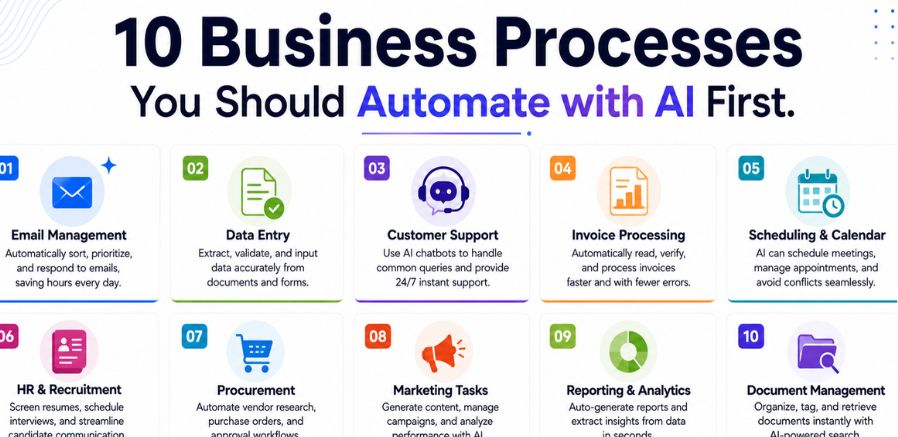
10 Business Processes You Should Automate with AI First
Business processes you should automate with AI are those that consume significant time, rely on repetitive tasks, and directly impact productivity, operational efficiency, and customer experience. As businesses accelerate their digital transformation initiatives, partnering with an AI development company has become a strategic way to automate complex workflows, reduce manual effort, and improve decision-making through intelligent automation.
Whether you're a startup, SME, or large enterprise, investing in professional AI development company helps identify high-impact automation opportunities across sales, customer support, HR, finance, marketing, and operations. Instead of automating every workflow, businesses should focus on processes that deliver measurable ROI, increase productivity, and create scalable, data-driven operations. In this guide, we'll explore the ten business processes that should be automated with AI first to maximize efficiency and long-term business growth.
Why AI Automation Should Be Your Business Priority
Many organizations still spend countless hours on manual processes such as responding to customer queries, processing invoices, qualifying leads, or generating reports. These repetitive tasks slow growth and increase operational costs.
AI-powered automation helps businesses:
- Reduce manual effort and operational expenses
- Improve speed and accuracy
- Eliminate repetitive work
- Enhance customer satisfaction
- Enable data-driven decision-making
- Scale operations without significantly increasing workforce
The following business processes typically deliver the fastest return on investment when automated.
1. Customer Support and Service
Customer service is one of the easiest and most valuable areas to automate. AI chatbots and virtual assistants can answer common questions, resolve routine issues, route complex requests to the right teams, and provide 24/7 support. This reduces response times while allowing support agents to focus on high-value customer interactions.
2. Lead Qualification and Sales Follow-Up
Sales teams often lose opportunities because they cannot respond quickly to every inquiry. AI can automatically capture leads, score prospects based on buying intent, schedule follow-ups, send personalized emails, and update CRM records. This improves conversion rates while shortening the sales cycle.
3. Invoice Processing and Financial Operations
Finance departments handle thousands of repetitive transactions every month. AI can extract invoice data, verify information, detect duplicate entries, process approvals, and automate payment reminders. This minimizes human error and accelerates financial workflows.
4. HR Recruitment and Employee Onboarding
Recruitment involves screening resumes, scheduling interviews, and managing candidate communication. AI simplifies hiring by identifying qualified candidates, matching skills with job requirements, automating interview scheduling, and streamlining onboarding activities. HR teams can focus more on people rather than paperwork.
5. Marketing Campaign Management
Marketing teams generate large volumes of content and campaign data. AI can automate email campaigns, social media scheduling, customer segmentation, SEO recommendations, content creation, and campaign performance analysis. This enables marketers to execute campaigns faster while improving personalization.
6. Document Processing
Businesses manage contracts, purchase orders, compliance documents, and business records daily. AI-powered document processing automatically extracts information, classifies documents, summarizes content, and validates data. This significantly reduces manual processing time while improving accuracy.
7. Inventory and Supply Chain Management
Inventory planning becomes increasingly complex as businesses grow. AI predicts demand, monitors stock levels, identifies supply chain risks, and recommends optimal inventory levels. These insights help reduce stock shortages, minimize excess inventory, and improve operational efficiency.
8. Business Reporting and Analytics
Creating reports manually often delays important business decisions. AI automatically collects data from multiple systems, generates dashboards, identifies trends, and provides actionable insights in real time. Decision-makers gain faster visibility into business performance without relying on manual spreadsheets.
9. Email and Internal Communication
Employees spend a significant portion of their workday managing emails and internal communication. AI can prioritize messages, summarize conversations, draft responses, schedule meetings, and organize communication based on urgency. This improves productivity across departments.
10. Internal Workflow and Approval Processes
Routine approvals such as leave requests, purchase orders, expense claims, IT tickets, and compliance checks can create unnecessary delays. AI automates these workflows by routing requests, sending reminders, tracking approvals, and notifying stakeholders, resulting in faster operations and improved governance.
How to Choose the Right Process to Automate
Not every workflow should be automated immediately. Start by identifying processes that are repetitive, rule-based, time-consuming, and involve high transaction volumes. Prioritize workflows that directly affect customer experience, operational efficiency, or revenue generation. Measuring KPIs such as processing time, error rates, and cost savings will help demonstrate the value of AI automation and support future expansion across the organization.
Conclusion
AI automation is no longer limited to large enterprises. Businesses of every size can achieve significant productivity gains by automating repetitive, data-intensive processes. From customer support and sales to finance, HR, marketing, and operations, intelligent automation enables teams to work faster, make better decisions, and focus on strategic initiatives.
Organizations that adopt AI strategically—starting with high-impact business processes—are better positioned to reduce costs, improve customer experiences, and scale sustainably. Partnering with an experienced AI development company can help ensure seamless integration with your existing systems and maximize the long-term value of your AI investment