 Chat with us
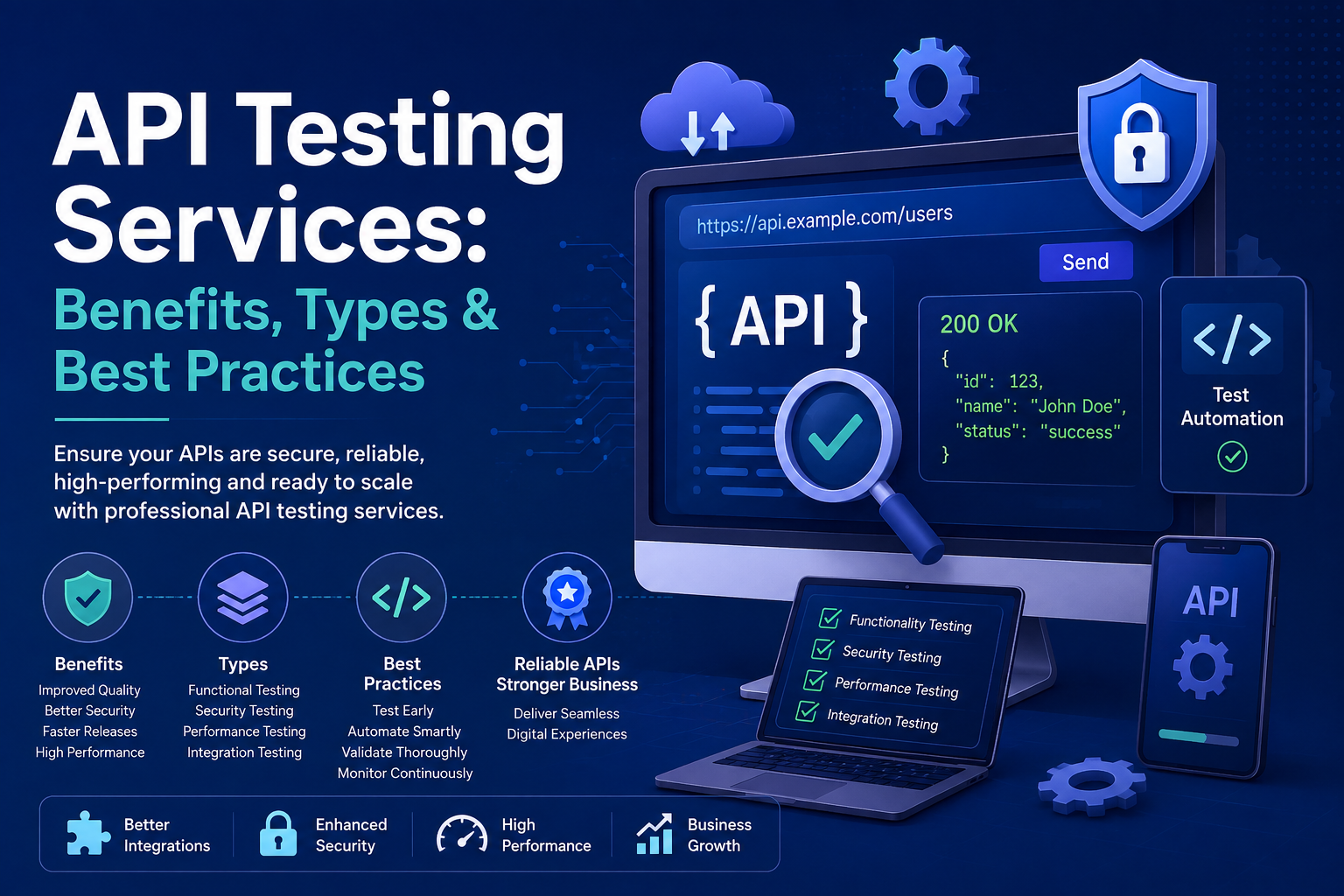
What Is API Testing? Importance, Types & Best Practices
API Testing is the process of testing Application Programming Interfaces (APIs) to ensure they work correctly, securely, reliably, and efficiently. Modern websites, mobile applications, SaaS platforms, and enterprise systems rely heavily on APIs to exchange data and connect different software components.
A problem with an API can affect multiple features, causing failed transactions, incorrect data, authentication issues, slow performance, or broken integrations. This makes API Testing Services an important part of modern software quality assurance.
What Is API Testing?
API testing involves directly testing an API to verify its functionality, data accuracy, security, performance, and reliability. Instead of focusing on the application's visual interface, API testing evaluates the communication layer between different software systems.
QA teams send requests to API endpoints and check whether the responses match the expected results. Testing may include HTTP methods, request parameters, headers, authentication, response codes, response data, error handling, and business logic.
API testing is commonly performed for REST, SOAP, GraphQL, and other API architectures.
Why Is API Testing Important?
1. Improves Application Reliability
APIs often connect critical components of an application. Testing them helps identify communication errors, incorrect responses, and integration problems before they affect users.
Reliable APIs contribute to more stable websites, mobile apps, and business applications.
2. Ensures Data Accuracy
APIs frequently transfer customer, product, order, payment, and business data between systems. API testing verifies that information is correctly transmitted, processed, and returned.
This is particularly important for applications where inaccurate data can affect business operations or customer experiences.
3. Strengthens API Security
APIs can provide access to sensitive information and important application functions. Security testing helps identify weaknesses related to authentication, authorization, access control, input validation, and sensitive data exposure.
Businesses handling financial, personal, or confidential information should include appropriate API security testing within their QA strategy.
4. Identifies Performance Issues
An API may function correctly during normal usage but experience problems when traffic increases. API performance testing evaluates response time, throughput, concurrent requests, and behavior under different workloads.
This helps businesses identify performance bottlenecks and scalability concerns before they become major production issues.
5. Supports Faster Software Releases
Modern development teams frequently release new features and updates. Repeating API tests manually can become time-consuming.
Automated API testing allows repetitive test cases to run quickly and consistently. Automated tests can also be integrated into CI/CD pipelines, helping development and QA teams receive faster feedback.
Types of API Testing
A comprehensive API testing strategy can include several testing methods:
Functional API Testing: Verifies that API endpoints and business functions produce the expected results.
Integration Testing: Checks communication between APIs, databases, applications, microservices, and third-party systems.
Security Testing: Evaluates authentication, authorization, access controls, and other security mechanisms.
Performance Testing: Measures API response times, throughput, scalability, and behavior under different workloads.
Regression Testing: Ensures existing API functionality continues to work after code changes or new releases.
Validation Testing: Checks response formats, data values, status codes, headers, and business rules.
API Testing vs UI Testing
API testing and UI testing serve different purposes. API testing focuses on backend communication, data, business logic, and integrations, while UI testing evaluates the application's interface and user workflows.
API tests can often provide faster feedback because they test functionality without going through the complete user interface. However, UI testing remains important for validating the actual customer experience.
For modern applications, combining API and UI testing can provide broader test coverage.
Manual vs Automated API Testing
Manual API testing is useful for exploratory testing, new endpoint validation, debugging, and situations where test scenarios change frequently.
Automated API testing is useful for repetitive tests, regression testing, continuous integration, and applications with frequent releases.
A balanced testing strategy often uses both manual and automated API testing based on project requirements.
Popular API Testing Tools
QA teams can choose from several API testing tools and frameworks, including:
- Postman
- REST Assured
- SoapUI
- JMeter
- Karate
- Cypress
- Playwright
The appropriate tool depends on the API architecture, programming environment, automation requirements, CI/CD setup, and testing objectives.
Best Practices for API Testing
Businesses can improve API quality by following these practices:
- Define clear API testing requirements.
- Test both valid and invalid requests.
- Validate response data, not just status codes.
- Automate repetitive regression tests.
- Include security and authorization testing.
- Test APIs under realistic workloads.
- Integrate automated tests into CI/CD pipelines.
- Maintain test cases as APIs evolve.
- Prioritize critical business workflows and integrations.
Why Choose Professional API Testing Services?
Professional API Testing Services can provide specialized QA expertise for businesses developing web applications, mobile apps, SaaS products, enterprise software, and integrated digital platforms.
Askzenix Technologies can support API testing through functional testing, automation testing, regression testing, integration testing, performance testing, and other software QA practices based on project requirements.
Frequently Asked Questions
What is API testing in simple terms?
API testing checks whether different software components communicate correctly and whether APIs return the expected data and responses.
Can API testing be automated?
Yes. API testing can be automated using tools and frameworks such as Postman, REST Assured, SoapUI, Karate, Cypress, and other technologies.
Why is API testing important for businesses?
It helps improve software reliability, data accuracy, security, integration quality, and performance while reducing the risk of API-related production issues.
When should API testing start?
API testing should begin as early as practical in the software development lifecycle and continue as APIs are modified, integrated, and deployed.
Conclusion
API testing is essential for modern applications because APIs connect critical software components, services, databases, and third-party platforms. A structured API testing strategy can help businesses identify functional defects, security weaknesses, data problems, integration failures, and performance issues before they impact users