 Chat with us
Node.js Application Migration When Is It Time to Move an Existing Backend to Node.js
Businesses often reach a point where an existing backend starts limiting application performance, development speed, scalability, or future product plans. At that stage, migrating the backend to Node.js can become a practical technology decision. But migration should not happen simply because Node.js is popular. The real question is whether the existing backend is creating measurable technical or business limitations.
Node.js is widely used for web applications, APIs, real-time platforms, SaaS products, and microservices because its event-driven, non-blocking architecture can efficiently handle applications with many concurrent I/O operations. A successful Node.js application migration, however, requires careful planning rather than simply rewriting an existing backend in a different language.
What Is Node.js Application Migration
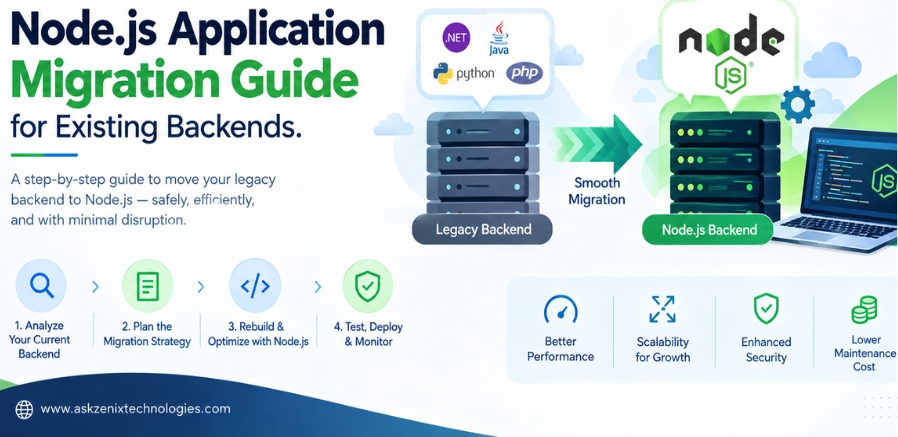
Node.js application migration involves moving an existing backend, APIs, business logic, integrations, or selected services from the current technology stack to Node.js.
The migration does not always require rebuilding the entire application. Businesses can gradually migrate specific services, APIs, or high-traffic components while keeping the existing backend operational. This approach can reduce migration risk and allow teams to validate performance before expanding the project.
When Should You Consider Migrating to Node.js
One common reason for migration is scalability. If your existing backend struggles with a growing number of simultaneous requests, Node.js may provide a suitable architecture for workloads that involve frequent database queries, API calls, network requests, and other I/O operations.
Development speed can also influence the decision. Node.js allows organizations to use JavaScript or TypeScript across different parts of the application stack. This can simplify collaboration between frontend and backend teams and make it easier to share development practices and certain types of code.
Another consideration is the need for real-time functionality. Applications involving chat, notifications, live dashboards, collaboration, tracking, or streaming can benefit from Node.js technologies designed around event-driven communication.
Migration can also make sense when an existing backend has become difficult to maintain because of outdated dependencies, limited developer availability, fragmented services, or expensive infrastructure requirements.
Should You Rewrite the Entire Backend
Not necessarily.
A complete rewrite can introduce significant technical and operational risk. A gradual migration strategy is often more practical for established applications. Businesses can begin by identifying services that experience performance bottlenecks or require frequent development changes.
These components can then be rebuilt as Node.js services while the existing backend continues serving other parts of the application. Over time, more functionality can be migrated based on measurable results.
How to Plan a Node.js Backend Migration
Before migration, evaluate the current architecture, application dependencies, APIs, database structure, traffic patterns, security requirements, and performance bottlenecks.
The technology team should define measurable migration objectives such as improved response times, easier deployment, better scalability, reduced maintenance effort, or faster feature development.
A proof of concept can help validate the proposed Node.js architecture before committing to a large-scale migration. Testing should cover APIs, authentication, database operations, integrations, security, performance, and failure scenarios.
Data migration also requires careful planning. Depending on the application, the database may remain unchanged during the initial migration, reducing unnecessary complexity.
Common Challenges During Node.js Migration
Backend migration can involve challenges such as differences between programming languages, legacy business logic, database compatibility, third-party integrations, authentication mechanisms, and deployment environments.
Another important consideration is performance testing. Node.js can be highly effective for I/O-intensive workloads, but technology selection should always depend on the application's specific requirements. CPU-intensive workloads may require additional architectural approaches such as worker threads, background processing, or separate services.
How Much Does Node.js Application Migration Cost
The cost depends on application size, backend complexity, database architecture, number of integrations, migration strategy, testing requirements, and the amount of legacy code involved.
A small API migration may require considerably less effort than migrating a large enterprise platform with multiple services and integrations. A technical audit and migration assessment can provide a more realistic estimate than using a generic development cost.
Final Thoughts
Node.js application migration can be valuable when an existing backend creates scalability, maintenance, development, or integration challenges. However, migration should be driven by measurable business and technical requirements rather than technology trends.
A phased migration approach, supported by architecture assessment, automated testing, performance monitoring, and clear success criteria, can help businesses modernize their backend while reducing unnecessary disruption.
Businesses planning a backend modernization project can evaluate their current architecture and identify which services should be migrated first. Askzenix Technologies provides Node.js development services and backend modernization services for businesses looking to build, migrate, and scale modern web applications.